
Home » Posts tagged 'Renaissance' (Page 2)
Tag Archives: Renaissance
Ottaviano Petrucci and the First Printed Lute Books

Frontispiece of Harmonice Musices Odhecaton ~ Canti A (1501) by Ottaviano Petrucci
The Lute Part VII
He did not compose for lute nor was he known to perform on it, but Ottaviano Petrucci (1466 – 1539) was nonetheless a vital figure in the history of the instrument, and profoundly influenced the course of musical development in the 16th century, and indeed music history in general.
Petrucci was an Italian printer and a pioneer in the publication of music printed from moveable type. In Venice at the very beginning of the Cinquecento, Petrucci produced the first known example of printed polyphonic music: a collection of secular songs titled Harmonice Musices Odhecaton, in 1501.
He also was the first to print instrumental music: several books of lute tablature, produced in 1507 and 1508. Today he is known as the father of modern music printing.
The Tallis Scholars Sing Josquin

The Tallis Scholars ~ photo © Eric Richmond
I don’t like to think of myself as a critic or a reviewer, but occasionally I make a raid into the territories inhabited by these creatures. Last week the English choir The Tallis Scholars released a new CD of Josquin Masses, and as I marveled for the ten-thousandth time at the sublime accomplishment of this ensemble in the stolen moments I was able to spend listening to it, I decided not to let it pass without remark.
Just in case you aren’t familiar with them, The Tallis Scholars were founded in 1973 by their director Peter Phillips, and are the world’s leading performers of renaissance polyphony. A good argument could also be made that they are the finest and most accomplished choir in the world, and the finest early music ensemble – notwithstanding their occasional foray into contemporary choral literature. (more…)
In Dulci Jubilo

the opening of In dulci jubilo, Piæ Cantiones, 1582
Part of a series of articles on
Preparing a School Winter Solstice Performance
In dulci jubilo is a famous medieval Christmas carol. It is a macaronic carol (i.e. the text is in a mixture of languages): the original text alternates between German and Latin. The words are attributed to the German mystic (and student of Meister Eckhart) Heinrich Seuse (1295 – 1366), and describes his vision of singing angels dancing with him.
It is one of our oldest, loveliest, and most important carols. The lilting, singsongy, exuberant melody and the relative ease with which they were able to learn it made it popular with my students of all ages – from elementary through high school. Although not a piece I included as an annual repeating feature of Winter Solstice performances, I would program In dulci jubilo every few years, and most of my students sang or played it in a Winter Solstice production at some point.
The Lute Society of America Summer Seminar West, 1996

masterclass with Paul O’Dette, Lute Society of America Summer Seminar West, Vancouver Early Music Festival 1996
The Lute Appendix iv
In the summer of 1996, I attended The Lute Society of America‘s Summer Seminar West in Vancouver, BC. The event took place from July 29 – August 2, 1996 at the Vancouver Early Music Festival held at The University of British Columbia.
Earlier this month the LSA held the 2016 summer seminar at Case Western Reserve University in Cleveland, and as my FaceBook feed was briefly inundated with photos and videos that attendees posted on the LSA FaceBook Group, I found myself reminiscing about my experience in Vancouver twenty years ago. It was one of the most memorable weeks of my life.
Petrarch’s Lyre

The Lute Part IV
The Lute and the New Humanists
The lute was already well-established as a favorite instrument in Italy by the 14th century (the Trecento). The happy circumstances that led to the rise of the lute as the emblematic and most revered instrument of the European Renaissance can be traced to its being readily on hand for the new humanist philosophers and poets who created the movement.
Already the lute was so familiar that in the early years of the century Dante (1265-1321) had used this simile to describe the counterfeiter Master Adam encountered in the eighth circle of Hell:
Io vidi un, fatto a guisa di lēuto
(I saw one, who would have been shaped like a lute)~ Inferno XXX, 49

Inferno: Canto XXX by Priamo della Querci (c.1400-1467) ~ surely the potbellied man in the scene on the right is Dante’s Master Adam
But Petrarch actually played the lute, and equating it with the the lyre of Classical Greece, he imbued the cultural perception of the instrument with a rich symbolism that permeated European art, music, and poetry for centuries.
Francesco da Milano
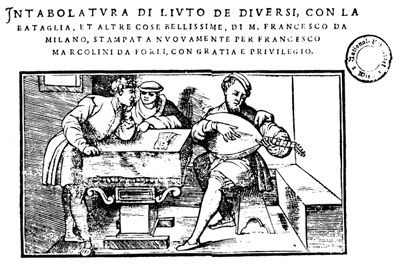
woodcut (of Francesco da Milano?) ~ the cover of Intabolatura di liuto published in Venice in 1536 by Francesco da Forli
The Lute Part II
In one of my first lute lessons with Pat O’Brien (c. 1993) I must have enthused about the music of Francesco da Milano, which I had been listening to on one of the first CDs of lute music I came across at Tower Records, a collection of this composer’s works played by Paul O’Dette that had just been released by Astrée. (This superb recording – still one of my very favorites – is now out of print.)
In what I was to learn was Pat’s typical unrestrained style, he took down two large, thick, heavy, volumes off of the bookshelves that lined the back wall of his studio – or perhaps dug them out from under a pile of other books, I don’t remember – and put them in my hands. This was Arthur Ness’s monumental The Lute Music of Francesco Canova da Milano published by Harvard University Press in 1970, which by then I believe was out of print and generally difficult to come across. American musicologist Arthur Ness is to Francesco like Ludwig von Köchel is to Mozart: Ness was the first to collect all Francesco’s known works from prints and manuscripts found in libraries all across Europe, catalog, and number them. As Mozart’s works are known by their Köchel numbers, Francesco’s extant pieces are known and differentiated by their Ness numbers – especially helpful as more than ninety of them are either untitled or simply named Fantasia or Ricercar in the original sources.
Nashville Early Music Festival 2015: Saturday
Part 2 of 2
This is the conclusion of the story I began in Nashville Early Music Festival 2015: Prelude & Friday

Participants Chorus – Mareike Sattler is not pictured as she was taking the photo
Saturday
On Saturday morning I made it back to Lipscomb before the 9 am voice masterclass in Ward Hall with Margaret Carpenter. Brooke sang first and worked with Margaret for a half hour, followed by countertenor Patrick Dailey, who sang Thomas Campion’s Never Weather-Beaten Saile: another lute song, which I also accompanied. Margaret had many helpful suggestions for each singer – mostly focusing on expression – and the hour went by quickly. I ended up staying in the room for the next session as well – Participants Chorus with Terri Richter and Mareike Sattler – and served as impromptu accompanist as we sight read sections of Vivaldi’s Gloria.
Nashville Early Music Festival 2015: Prelude & Friday
 Part 1 of 2
This past weekend I had the great pleasure of participating in Music City’s first ever festival dedicated to music from before the time of Haydn, Mozart, and Beethoven. The inaugural Nashville Early Music Festival was held Friday & Saturday, September 25 & 26 at Lipscomb University (the festival’s sponsor), and included copious performances of (mostly) baroque music by local musicians as well as visitors from around the country, as well as more informal presentations, masterclasses, and opportunities for musicians, students, and anyone else interested in Early Music to listen, learn, converse, enthuse, and make friends.
I know that I am not alone in hoping that this is only the first annual event for a festival that will grow into a tradition, bringing Early Music to Nashville for years to come.
Meet the Lute
Is it not strange that sheep’s guts could hail souls out of men’s bodies?
William Shakespeare
Much Ado About Nothing, 2.3.57-58

musician angel by Rosso Fiorentino (Giovanni Battista di Jacopo), circa 1520
The first in a series of posts about the lute.
I would wager that while many, perhaps even most people in our culture have heard of the instrument called the lute and may even know what it looks like, most have never heard one played – either live or on a recording. Yet this paragon of musical instruments, this “instrument of angels” was the most popular instrument in Europe for hundreds of years. Throughout the Renaissance, the lute occupied a position in European society analogous to that of the piano in the nineteenth century. Lute virtuosi played for royalty and popes and were famous throughout the continent, and a rising middle class created demand for the new industry in printed sheet music, providing for music making at home. The art of music took its place at the center of culture on an unprecedented scale. This musical revolution gave birth to the invention of the instruments we use today and intensified the position of music at the heart of both religious and secular ceremonies, while the public and royalty alike acknowledged famous musicians as celebrities and prophets. At the forefront of all this was the lute – a symbol of music’s divine place in human life and the most popular musical instrument of the age.
Meet The Recorder

1996 (click images to enlarge)
This is the first in a series of occasional posts about the recorder, its historical and contemporary repertoire, its champions, and its place in music education.
Being a recorder player has been a humbling experience. The recorder is not highly regarded in American musical culture, and most people who know of the instrument only know it because they were given a cheap plastic recorder in elementary school and learned to play a few simple tunes on it in a classroom setting. Occasionally I meet someone who is familiar with it from its occasional use by folk music groups or recognizes the instrument from the opening of Led Zeppelin’s Stairway to Heaven (or perhaps I’ve Seen All Good People by Yes). Most people – including many classical musicians I have met, and many elementary school music teachers who actually teach recorder to their music classes – are unaware of or uninformed about the recorder’s long history, or of its beautiful if modest historical repertoire that includes works written specifically for recorder by masters including J.S. Bach, Händel, and Vivaldi, or of it’s employment in virtuosic avant-garde compositions since the 1960s.
 Walter Bitner