
Home » Posts tagged 'The Lute' (Page 2)
Tag Archives: The Lute
The Lute at the Court of Henry VIII
The Lute Part XII
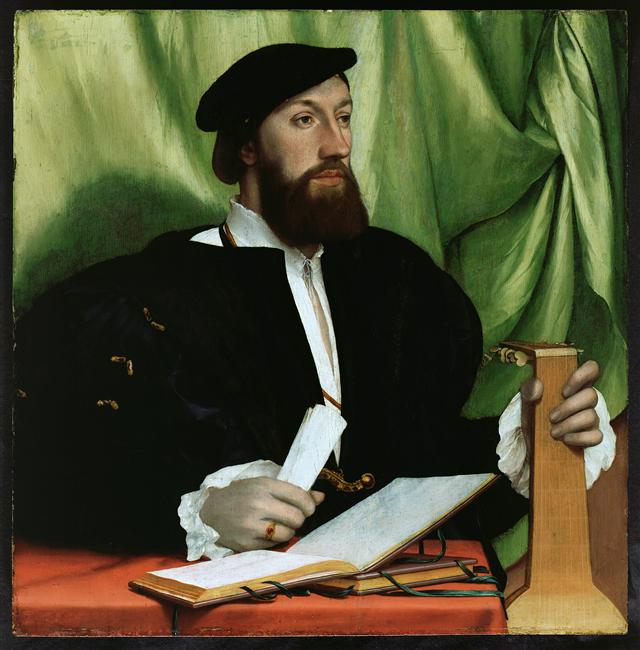
Unknown Man with Lute by Hans Holbein the younger (1497/8 – 1543), Berlin, Gemäldegalerie ~ American musicologist John Ward speculated that this might be Philip van Wilder, but David Van Edwards has cast doubt on this theory here. (click images to enlarge)
When Henry VIII (1491 – 1547) ascended to the throne of England in 1509, the lute did not play the prominent role in English society and culture it would come to hold by the end of the 16th century. In addition to his matrimonial activities, waging war in France, and reforming the church, it is well known that Henry VIII was an enthusiastic musician, and even composer. He invigorated and developed the musical aspects of life at the English court in the first half of the 16th century far beyond what they had been under previous English monarchs, employing dozens of musicians, including lutenists (or lewters, as they appear in contemporary account books).
Before Henry VIII, the English court was still heavily influenced by Burgundian culture, and use of the harp superseded the lute there until the end of the 15th century. The lute rose to prominence in England by the second half of the 16th century, lagging behind much of the continent by a couple of generations.
2017: What Kind of Blog Is This?

Off The Podium Reflections, Statistics, and Top Ten Posts
In what is becoming an annual tradition, here I review my experience writing Off The Podium over the course of the year and share some statistics. We will also see if I have learned anything and I will attempt to describe what this blog – which sometimes goes off in unexpected directions – is all about.
2017 was a very full year, packed with many significant events and activities. Off The Podium continues to provide a great means to share the activities of the department of Education & Community Engagement at the Nashville Symphony with the world. It also remains a productive format that has inspired me to continue to develop my writing on the topics of Music and Education – these features of Off The Podium reach thousands of readers all over the world and have brought me into contact with many musicians and educators I would otherwise have had no opportunity to meet or correspond with.
Thank you everyone for your continued encouragement and support.
Renaissance Lute
The Lute Part V

Lutes ~ Plate XVI from Michael Praetorius: Syntagma Musicum, 1619 (click to enlarge)
In which I offer some observations about the instruments themselves and how they were tuned
If someone finds out that I play the lute, it’s not uncommon to be asked: “oh…what is that?” I’ve even been asked “do you blow it?” once or twice. For non-lutenists – and especially non-musicians – distinctions between this or that lute are esoteric details.
But when one lutenist meets another and they both realize their common pastime (or obsession), often the first question that comes up is: do you play renaissance or baroque?
Attaingnant’s Lute Books

facsimile of Attaingnant’s Tres breue et famílíere introductíon… (1529) by Editions Minkoff, Geneva, 1988 (click to enlarge)
The Lute Part XI
continued from
Music Printer to the King: Pierre Attaingnant
In 1529, Pierre Attaingnant published the first book of lute tablature to be issued in France: Tres breue et famílíere introduction pour entendre & apprendre par soy mesmes a iouer toutes chansons reduictes en la tablature du Lutz. (Brief and simple introduction for understanding and learning for oneself how to play any song reduced to tablature for the lute.) Hereafter: Introduction.
This first volume of lute pieces to be printed in France – a collection of preludes and chansons – was followed less than four months later by a second volume – Dixhuit basses dances: 18 basses dances as well as branles, pavanes, galliards, and other dances in lute tablature.
Together, these two small books comprise the humble beginning of the long tradition of French lute music, which was eventually to dominate the solo lute repertoire throughout the continent. By the middle of the 17th century, “French lute” would represent the apotheosis of refined expression in instrumental music and the repertoire of the French lutenists would in turn influence the fledgling keyboard repertoire… but that’s getting considerably ahead of our story.
Music Printer to the King: Pierre Attaingnant
The Lute Part X

portrait of Francis I of France (1494-1547) c.1530 by Jean Clouet (1475-1540), Louvre Museum, Paris (click to enlarge)
The French Renaissance is sometimes called the “long sixteenth century” by historians to describe a period from the end of the 15th through the beginning of the 17th centuries. During this period, the arts and culture flourished anew as France imported humanism, artistic ideals, and their proponents from Italy and adapted them according to French tastes and aesthetics. In the first half of the 16th century the French King Francis I – François Premier – was a great patrons of the arts and the epitome of the renaissance monarch: a poet himself, it was under his reign (1515 – 1547) that this cultural transformation took place most dramatically.
It was also during the reign of Francis I that the very first printed music books appeared in France – including the first printed lute books.
The Capirola Lute Book
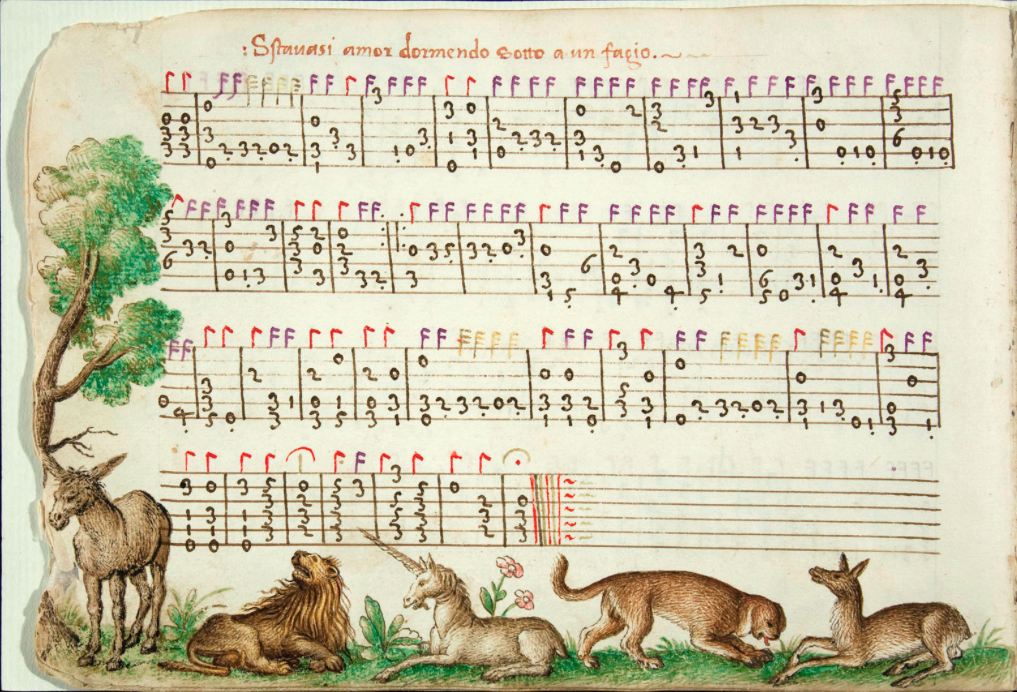
a page from the Capirola Lute Book (click to enlarge)
The Lute Part IX
In the early 16th century an amateur lutenist in Venice compiled an undated manuscript consisting of lute pieces in Italian tablature composed by his teacher. He names himself Vidal in the book’s preface, and states that in order to ensure that the music contained in its pages is preserved, he has decorated it with “noble pictures” so that it will be treasured for their sake should the book come into the possession of some who may not appreciate music. Indeed, 45 of the manuscript’s 147 pages feature elaborate pastoral illustrations in full color, and the book has been preserved: this is the famous Capirola Lute Book. It is one of the earliest and finest manuscripts of lute music to survive – perhaps the most beautiful – and it contains the only known selection of music by one of the the early 16th century’s finest lutenists, a Brescian nobleman named Vincenzo Capirola.
The Frottolists and the First Lute Songbooks

Un Concerto, c. 1485-1495 by Lorenzo Costa (1460-1535) ~ National Gallery, London
The Lute Part VIII
continued from
Ottaviano Petrucci and the First Printed Lute Books
From the end of the 15th century into the first decades of the 16th century – a period estimated by historians to be from about 1470-1530 – a secular polyphonic song genre known as frottola flourished throughout the courts of Italy. This poetic and musical movement paved the way for a distinctly Italian musical renaissance style featuring primarily Italian musicians and composers in contrast to the dominance of composers from Northern Europe in Italy from the 14th – 15th centuries, and prepared a fertile ground for the development of the madrigal later in the 16th century.
Hand in hand with the rise of the frottola was the development of a revolutionary technique that allowed musicians to play polyphonic music in 2, 3, or more parts on one lute. By the end of the 15th century, most lutenists had dropped their plectrums in favor of the new style, and plucked the strings with the fingers of the right hand. When Petrucci published the first books of lute tablature beginning in 1507, all of them and all of the tablature that followed for the next next two and a half centuries assumed the new technique.
Ottaviano Petrucci and the First Printed Lute Books

Frontispiece of Harmonice Musices Odhecaton ~ Canti A (1501) by Ottaviano Petrucci
The Lute Part VII
He did not compose for lute nor was he known to perform on it, but Ottaviano Petrucci (1466 – 1539) was nonetheless a vital figure in the history of the instrument, and profoundly influenced the course of musical development in the 16th century, and indeed music history in general.
Petrucci was an Italian printer and a pioneer in the publication of music printed from moveable type. In Venice at the very beginning of the Cinquecento, Petrucci produced the first known example of printed polyphonic music: a collection of secular songs titled Harmonice Musices Odhecaton, in 1501.
He also was the first to print instrumental music: several books of lute tablature, produced in 1507 and 1508. Today he is known as the father of modern music printing.
The Lute Society of America Summer Seminar West, 1996

masterclass with Paul O’Dette, Lute Society of America Summer Seminar West, Vancouver Early Music Festival 1996
The Lute Appendix iv
In the summer of 1996, I attended The Lute Society of America‘s Summer Seminar West in Vancouver, BC. The event took place from July 29 – August 2, 1996 at the Vancouver Early Music Festival held at The University of British Columbia.
Earlier this month the LSA held the 2016 summer seminar at Case Western Reserve University in Cleveland, and as my FaceBook feed was briefly inundated with photos and videos that attendees posted on the LSA FaceBook Group, I found myself reminiscing about my experience in Vancouver twenty years ago. It was one of the most memorable weeks of my life.
2015: What Kind of Blog Is This?

2015 Off the Podium Reflections, Statistics, and Top Ten Posts
Disclosure: self-indulgent meta-post follows
It’s the last week of 2015, and looking back I decided to review my experience writing Off the Podium this year and share some statistics, what I have learned, and in a way give an overview of what exactly this blog is about.
Writing has been something I have wanted to do for years now, and I began to write in secret some time ago, but it was last year’s career transition that found me leaving the classroom to work at the symphony that finally enabled me to begin writing in earnest. I just couldn’t put it off any more!
 Walter Bitner