
Home » Music (Page 9)
Category Archives: Music
Nashville Symphony EDCE at SphinxConnect 2017

Nashville Symphony EDCE staff with Aaron Dworkin, founder of Sphinx and Dean of University of Michigan School of Music, Theatre, & Dance, SphinxConnect, Detroit, February 10, 2017. (l to r) WB, Kelley Bell, Aaron Dworkin, Kimberly McLemore, Kristen Freeman.
Earlier this month – February 9-12, 2017 – our entire Nashville Symphony Education & Community Engagement Department attended the Sphinx Organization‘s 20th annual Competition and 5th annual conference in Detroit, retitled SphinxConnect this year.
We spent an eventful four days attending concerts, interviews, panel discussions, and presentations, several networking (and celebratory) receptions, and other meetings. Some 500 people were there from all over the country (and some from other countries as well), many of whom only see each other a few times per year. The entire conference was imbued with a heady excitement.
The 2017 Schermerhorn Invitational Choral Festival
 Today the Nashville Symphony hosted the first ever Schermerhorn Invitational Choral Festival at Schermerhorn Symphony Center.
Monday, February 6, 2017: three choirs from Middle Tennessee public high schools gathered for a day of music making on the stage of Laura Turner Hall under the direction of Dr. Tucker Biddlecombe, Interim Director of the Nashville Symphony Chorus and Director of Choral Activities at Vanderbilt University’s Blair School of Music.
A wonderful day of music and camaraderie was had by all as our beautiful concert hall was filled with the joyful sound of young people singing for and with each other. Here follows some impressions and photos from the day!
Renaissance Lute
The Lute Part V

Lutes ~ Plate XVI from Michael Praetorius: Syntagma Musicum, 1619 (click to enlarge)
In which I offer some observations about the instruments themselves and how they were tuned
If someone finds out that I play the lute, it’s not uncommon to be asked: “oh…what is that?” I’ve even been asked “do you blow it?” once or twice. For non-lutenists – and especially non-musicians – distinctions between this or that lute are esoteric details.
But when one lutenist meets another and they both realize their common pastime (or obsession), often the first question that comes up is: do you play renaissance or baroque?
Attaingnant’s Lute Books

facsimile of Attaingnant’s Tres breue et famílíere introductíon… (1529) by Editions Minkoff, Geneva, 1988 (click to enlarge)
The Lute Part XI
continued from
Music Printer to the King: Pierre Attaingnant
In 1529, Pierre Attaingnant published the first book of lute tablature to be issued in France: Tres breue et famílíere introduction pour entendre & apprendre par soy mesmes a iouer toutes chansons reduictes en la tablature du Lutz. (Brief and simple introduction for understanding and learning for oneself how to play any song reduced to tablature for the lute.) Hereafter: Introduction.
This first volume of lute pieces to be printed in France – a collection of preludes and chansons – was followed less than four months later by a second volume – Dixhuit basses dances: 18 basses dances as well as branles, pavanes, galliards, and other dances in lute tablature.
Together, these two small books comprise the humble beginning of the long tradition of French lute music, which was eventually to dominate the solo lute repertoire throughout the continent. By the middle of the 17th century, “French lute” would represent the apotheosis of refined expression in instrumental music and the repertoire of the French lutenists would in turn influence the fledgling keyboard repertoire… but that’s getting considerably ahead of our story.
Music Printer to the King: Pierre Attaingnant
The Lute Part X

portrait of Francis I of France (1494-1547) c.1530 by Jean Clouet (1475-1540), Louvre Museum, Paris (click to enlarge)
The French Renaissance is sometimes called the “long sixteenth century” by historians to describe a period from the end of the 15th through the beginning of the 17th centuries. During this period, the arts and culture flourished anew as France imported humanism, artistic ideals, and their proponents from Italy and adapted them according to French tastes and aesthetics. In the first half of the 16th century the French King Francis I – François Premier – was a great patrons of the arts and the epitome of the renaissance monarch: a poet himself, it was under his reign (1515 – 1547) that this cultural transformation took place most dramatically.
It was also during the reign of Francis I that the very first printed music books appeared in France – including the first printed lute books.
15th Annual Mozart Birthday Concerts

(l to r) Nashville Symphony musicians Gil Perel & Roger Wiesmeyer
Wolfgang Amadeus Mozart was born on January 27, 1756. For the 15th consecutive year, Roger Wiesmeyer’s Mozart in Nashville will present concert celebrations in honor of the Austrian wunderkind’s birthday. As in years past, this year’s events feature an ensemble of local musicians – including members of the Nashville Symphony, free-lance professionals, and amateurs – who will perform two benefit concerts for a local charity featuring music by Amadeus.
This year’s concerts will take place:
Friday, January 13, noon, at St. George’s Episcopal Church, 4715 Harding Road, Nashville.
Monday, January 23, 7 pm, at Edgehill United Methodist Church, 1502 Edgehill Avenue, Nashville.
This year’s concerts feature:
Piano Sonata in B flat Major, K. 333
Roger Wiesmeyer, piano solo
Bassoon Concerto in B flat Major, K. 191/186e
Gil Perel, bassoon solo
Mozart Birthday Festival Orchestra
Proceeds will benefit the Mary Parrish Center for victims of domestic abuse and sexual violence.
2016: What Kind of Blog Is This?
Off The Podium Reflections, Statistics, and Top Ten Posts
As I did last year at this time, here I review my experience writing Off The Podium this year and share some statistics, what I have learned, and come clean on what exactly this blog is about.
The year has been a wild ride. Off The Podium has provided a great means to share the activities of the department of Education & Community Engagement at the Nashville Symphony and the launch of our Accelerando program with the Nashville community and the world. It has also continued to provide me with a format and incentive to develop my writing on the topics of Music and Education – regular features of Off The Podium that now reach thousands of readers all over the world.
The Hallelujah Chorus
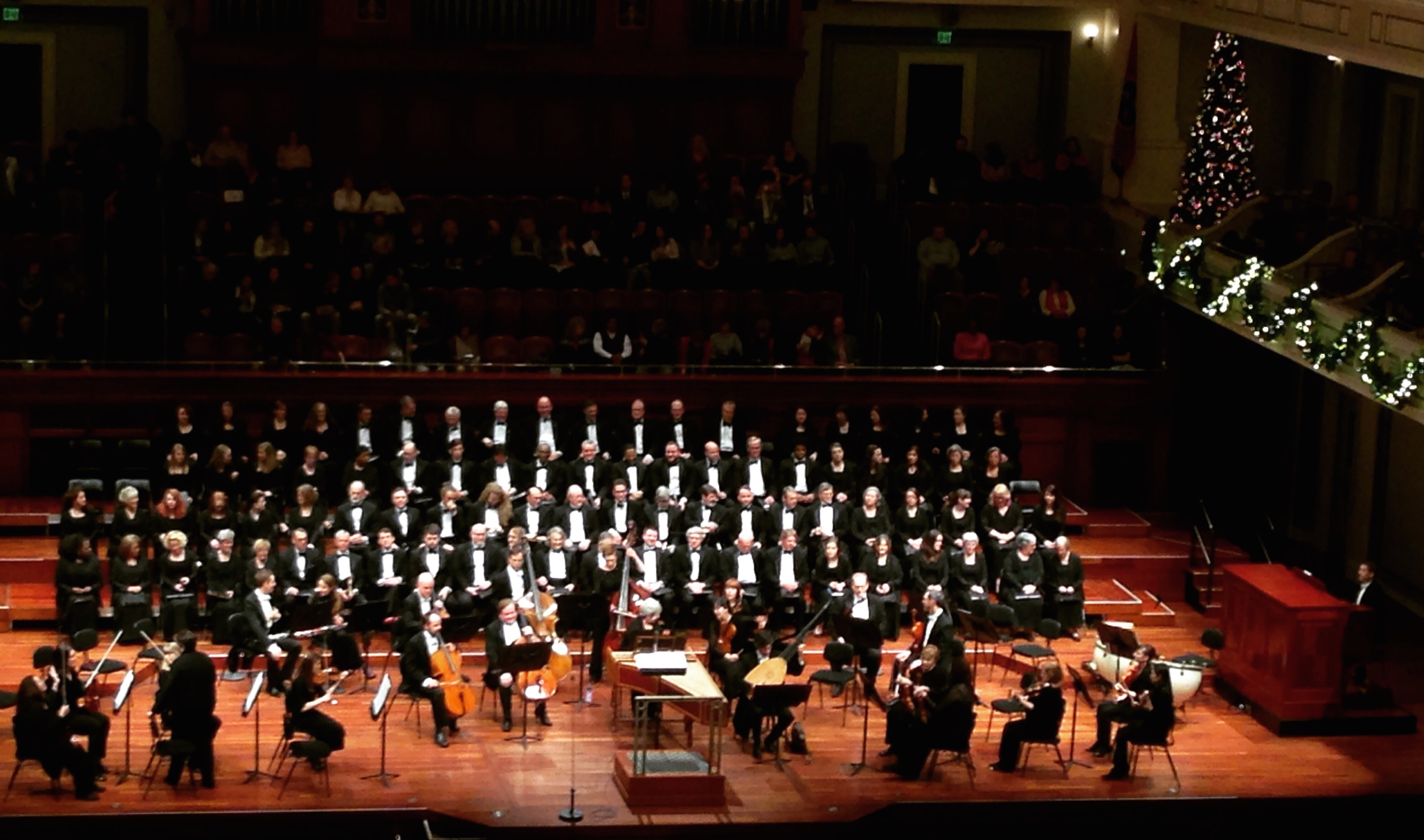
The Nashville Symphony and the Nashville Symphony Chorus gather onstage moments before a performance of Händel’s Messiah, December 18, 2016, Schermerhorn Symphony Center, Nashville
Part of a series of articles on
Preparing a School Winter Solstice Performance
This past week the Nashville Symphony performed our annual string of December Messiah concerts. An annual event featuring a different conductor and vision for the performance of this masterwork each year, it is remarkable to me how resilient Händel’s Messiah is, and how much the community here at the symphony -as well as the larger surrounding community of Music City – looks forward to it every year. It’s one of those monuments of the repertoire that has become part of the collective consciousness.
This year’s performance with guest conductor Christopher Warren-Green brought a historically-informed perspective to the performance, with brisk tempi and the incorporation of a theorbist who doubled on baroque guitar to the continuo section. I was thrilled to hear how excited our musicians were about Messiah this year in conversations I had with them (or overheard) during rehearsals. Sitting in the balcony on Sunday afternoon for the final matinee performance, the enthusiasm of the musicians and the audience was palpable. In the exhilaration following the concert I found myself thinking a lot about this remarkable piece of music, and especially one movement in particular – the unique and absolutely one-of-a-kind Hallelujah Chorus – and why and how it occupies such a singular place in our musical culture.
The Capirola Lute Book
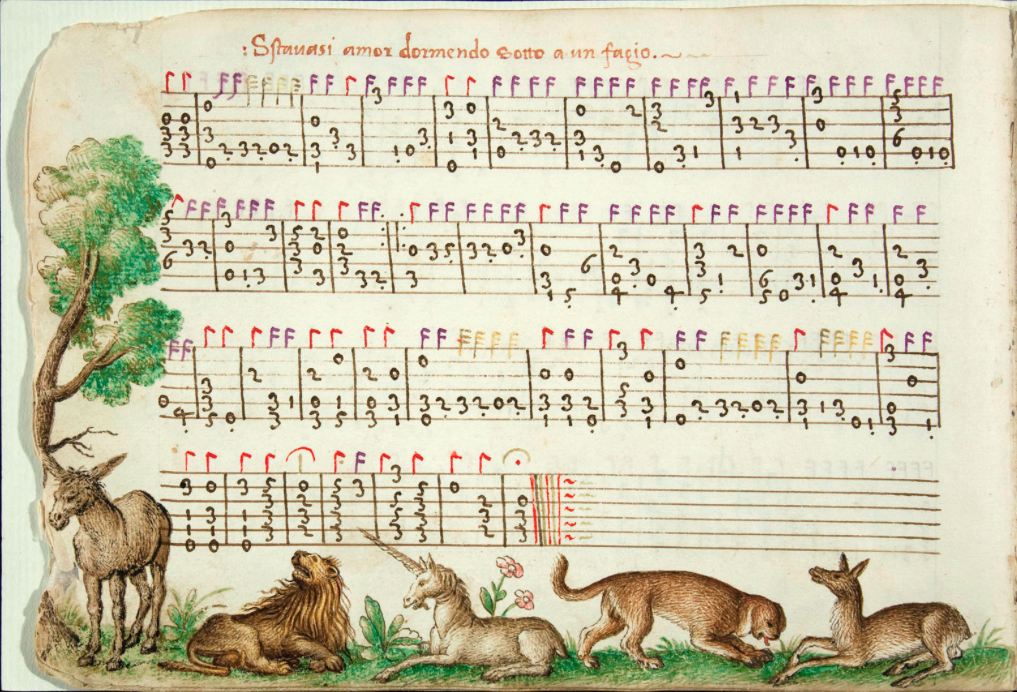
a page from the Capirola Lute Book (click to enlarge)
The Lute Part IX
In the early 16th century an amateur lutenist in Venice compiled an undated manuscript consisting of lute pieces in Italian tablature composed by his teacher. He names himself Vidal in the book’s preface, and states that in order to ensure that the music contained in its pages is preserved, he has decorated it with “noble pictures” so that it will be treasured for their sake should the book come into the possession of some who may not appreciate music. Indeed, 45 of the manuscript’s 147 pages feature elaborate pastoral illustrations in full color, and the book has been preserved: this is the famous Capirola Lute Book. It is one of the earliest and finest manuscripts of lute music to survive – perhaps the most beautiful – and it contains the only known selection of music by one of the the early 16th century’s finest lutenists, a Brescian nobleman named Vincenzo Capirola.
The Feast of Stephen
 Part of a series of articles on
Preparing a School Winter Solstice Performance
On December 8, 2006 – ten years ago today – my students at Linden Corner School in Nashville presented a winter solstice celebration for the school community called The Feast of Stephen.
The Feast of Stephen incorporated copious music as well as dance and theatrical elements, and every student from grades 3-8 was a performer. Students participated as singers, instrumentalists, actors, dancers, created props and costumes – preparing for this event consumed most of my time in October and November of 2006, and as the night of the show came near the anticipation and excitement among the children, parents, and myself was palpable.
Here is a description of The Feast of Stephen: an example of a winter solstice performance with elementary and middle school students that incorporates many of the elements described in this series of articles. Included are the original scripts of both The Feast of Stephen and the Linden Corner School Mummer’s Play, a copy of the original program, and a video of the performance.
 Walter Bitner