
Home » Music (Page 12)
Category Archives: Music
Meet Telemann

To his 18th century contemporaries, Georg Philipp Telemann was the most famous, influential, and highly-regarded German musician of the day. Four years older than his friends J.S. Bach and Händel – both of whose reputations have now eclipsed his – Telemann was more prolific than either, wrote sacred and secular, vocal and instrumental music in virtually every genre, published on a nearly unprecedented scale, and did more than any other musician of his time to break down barriers that kept music a separate and elite component of civic, court, and church ceremony to elevate the role of music in the life of the middle class.
Elgar, Poulenc, & Lauridsen at West End United Methodist
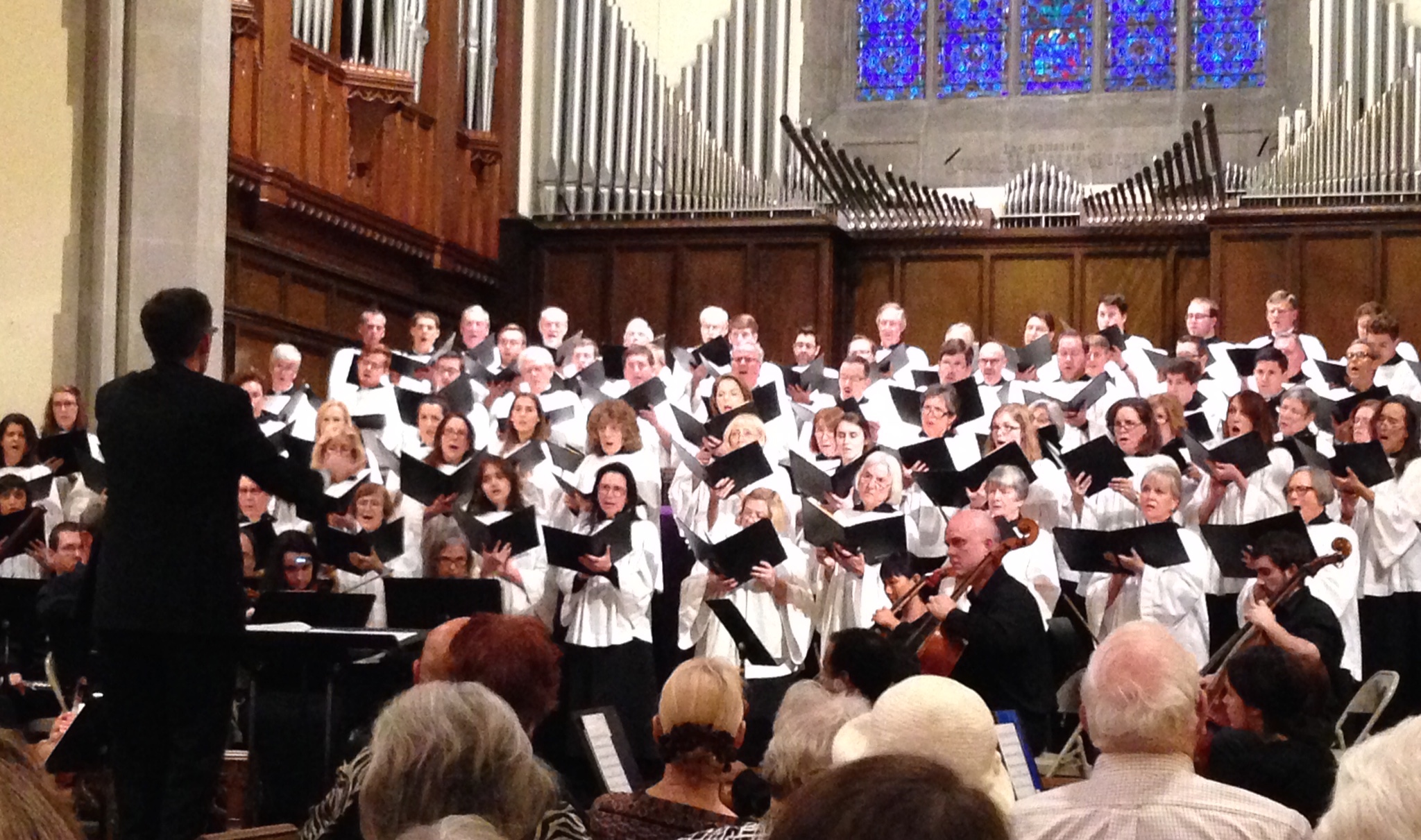
the combined Chancel & Sanctuary choirs of West End United Methodist Church perform Morten Lauridsen’s Lux Aeterna under the direction of Matthew Phelps ~ March 6, 2016, Nashville
The last week has been a flurry of music and activity – the symphony was in the hall rehearsing Rossini, Brahms, and Strauss on Tuesday, Wednesday, and Thursday for three performances: our annual High School Young People’s Concert on Friday morning, and Classical Series concerts on Friday and Saturday night. Also on Saturday, we held the first round of our annual Curb Concerto Competition – sixteen teenage instrumentalists competed for cash prizes and the chance to perform a concerto movement with the Nashville Symphony on the stage of Laura Turner Hall! – and on Sunday afternoon we held the competition’s finals. This coming Saturday is our first ever auditions for our new program Accelerando. It’s been a very busy time of year for the Education staff at the Nashville Symphony!
After the final round of the competition was over on Sunday, after photos had been taken and I said goodbye to the finalists and their families, I dashed off a quick email to the symphony’s publicist with details for the press release and then made my way across town to West End United Methodist Church for a special late afternoon concert.
Pictures at an Exhibition
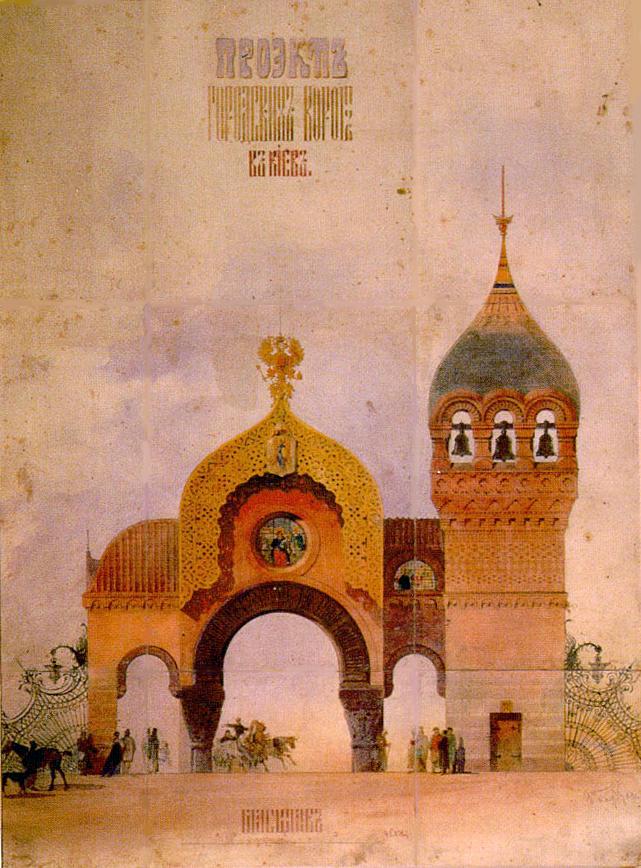
Viktor Hartmann: Plan for a City Gate in Kiev, watercolor, 1869
Modest Mussorgsky (1839 – 1881) was a Russian composer best known today for a few celebrated works, including Night on Bald Mountain – a musical depiction of a “witches sabbath” most often played on Halloween programs and other programs depicting musical grotesqueries – and Boris Gudunov, an opera based on a drama by Pushkin: the butt of one of the first classical music jokes music majors learn in undergraduate school:
Q: Why did Mussorgsky only write one opera?
A: Because one Boris Gudunov.
His most beloved composition today is Pictures at an Exhibition, which was originally written as a large suite for solo piano but is best known to the listening public as a large-scale symphonic work in its orchestration by the French composer Maurice Ravel (1875 – 1937).
2016 SphinxCon: Ignite to Action
 Earlier this month I traveled to Detroit to attend SphinxCon – the 4th annual conference on diversity in the arts presented by The Sphinx Organization. This was my first experience attending this conference, and it was a good experience, and particularly relevant to the work my department has been intensely engaged in: we are now in the midst of launching the Nashville Symphony’s new diversity program Accelerando. Our very first auditions for Accelerando will be held on March 12.
I returned to Nashville a week ago for a schedule turned upside down due to snowstorms, but many of my impressions from the weekend in Detroit have stayed with me, and I’ve tried to write down some of them here before the march of time goes on much longer and they recede into the background.
Music City Baroque & Vox Grata: Music from the Venetian Ospedali

Music City Baroque & Vox Grata perform music from the Venetian Ospedali, January 24, 2016, Westminster Presbyterian Church, Nashville ~ photo by George Riordan
Like much of this part of the country, last week Nashville was hit by a record snow storm – the largest snowfall recorded here in the last 28 years. Between 5 and 10 inches fell on Friday and Saturday, depending on what part of town you live in (8 inches was the official recorded snowfall at Nashville International Airport).
When snow falls here the city shuts down. Not only do schools and businesses close, but it’s simply not safe to be on the roads. We have few plows and they only attempt to clear main roads, leaving most neighborhoods treacherous and ice-bound. My family did not leave our house on Friday or Saturday, except on foot to walk the dog or to scout out the state of neighboring streets.
So by Sunday afternoon, when the city had begun to thaw out, I was happy to make my way across town to hear an afternoon concert of old music performed in collaboration by two local ensembles.
Is Music a Commodity?
 Our consumer culture has a strong tendency to overshadow other human values and reduce every aspect of human life and culture to an economic appraisal. This is as true of music as it is of anything else.
I’ve thought about this a lot over the years and discussed it many times with students and colleagues. Recently it was brought to my attention when a blog post about “the value of music” and “the state of the music industry” over at The Boot from a few years ago resurfaced on my FaceBook feed. The post is called Vince Gill Discouraged by “Mind-Numbing” Country Music.
14th Annual Mozart’s Birthday Concerts

detail from a portrait of Wolfgang Amadeus Mozart, painted in 1782 by his brother in law Joseph Lange. Mozart wrote the C minor piano concerto in the winter of 1785-86
This month Roger Wiesmeyer and an ensemble of local musicians – many of them members of the Nashville Symphony – will perform two benefit concerts for a local charity featuring music by Wolfgang Amadeus Mozart, as Roger has done every year at this time since 2003.
This year’s concerts will take place:
Friday, January 15, noon, at St. George’s Episcopal Church, 4715 Harding Road, Nashville.
Sunday, January 31, 6 pm, at Edgehill United Methodist Church, 1502 Edgehill Avenue, Nashville.
This year’s concert features the C minor piano concerto, K. 491 conducted by Vinay Parameswaran with Roger as piano soloist. Admission is $10, and all proceeds benefit The Contributor.
Orpheus

detail from Orpheus leading Eurydice from the Underworld by Jean-Baptiste-Camille Corot (1796-1875)
Apollo is the Sun. In the exalted solitude of his journey through the heavens each day, He hears the Harmony of the Spheres: the perfection of proportions in the orbits of the heavenly bodies – the Sun, the Moon, and the planets together resonating an etherial and celestial music never heard by mortals.
Perhaps it was this celestial harmony Apollo remembered when He saw young Hermes strumming on the strings of an instrument the child God had made from the shell of a tortoise. Hermes had stolen some of his cattle and Apollo was very angry, but when the Sun God heard the delicate yet enthralling sounds of Hermes’ lyre, His temper cooled and Apollo allowed Hermes to keep the cattle in exchange for the instrument. Apollo endowed the lyre with His solar power, inventing Music. Through His divine example He inspired men and women to live virtuously, to emulate the Gods, and to create Music and poetry for themselves.
2015: What Kind of Blog Is This?

2015 Off the Podium Reflections, Statistics, and Top Ten Posts
Disclosure: self-indulgent meta-post follows
It’s the last week of 2015, and looking back I decided to review my experience writing Off the Podium this year and share some statistics, what I have learned, and in a way give an overview of what exactly this blog is about.
Writing has been something I have wanted to do for years now, and I began to write in secret some time ago, but it was last year’s career transition that found me leaving the classroom to work at the symphony that finally enabled me to begin writing in earnest. I just couldn’t put it off any more!
Jazz

Ella Fitzgerald, late 1970s ~ photo by Gai Terrell
One night when I was a child – this would have been sometime in the 1970s – I was in bed but had not yet fallen asleep when my mother came to my room and got me to come see something important that was about to be shown on television.
This was back when all television was broadcast: before streaming, before cable, before Blu-Ray, DVD, VHS, or Beta. There were 3 commercial networks and PBS had only been broadcasting for a few years – so if something came on TV and it was important or interesting, you had to set aside time to watch it then or you would miss it, with no chance to see it again. In those days, many people organized their lives and made plans around the scheduled broadcasts of programs or events they wanted to see.
So I shuffled down the hall to my parents’ bedroom and sat on the edge of the bed in my pajamas, peering up at the small black-and white TV set that sat on a shelf high on the wall. (What seemed to my young eyes and ears like) a dowdily dressed old black woman in coke-bottle glasses stood in front of a piano trio and proceeded to astound me with the most outlandish and virtuosic singing I had ever heard. At first she sang what seemed to my limited experience to be a pretty conventional rendition (of a song I did not know – in my memory she sang How High the Moon and A-Tisket, A-Tasket in this broadcast but I don’t know if that’s accurate as I’ve been unable to locate a video on the internet that syncs with my memory of this moment) but then she closed her eyes and started to make strange movements with the hand not holding the microphone as she sang what become obvious to me was not the song but just something wild she was making up, singing nonsense. My mother told me this was called scat singing. I thought that scat was another word for poop but I didn’t say anything, I just sat there mesmerized, listening intently until it was over. I’d never heard anything like it.
It was Ella Fitzgerald of course. My father said something about Ella being the greatest jazz singer in the world, and it was clear to me (they got me out of bed to see this, after all) that to my parents – who seemed to regard this television event with the same weighty regard they had given to astronauts landing on the moon or President Nixon resigning from office – this crazy old lady was something special – anyway, she was on TV, and that was important in it’s own right. I went to bed when it was over, but sitting in my parents room that night watching Ella sing on TV made a strong impression on me, and I never forgot it.
It is my first “jazz” memory.
 Walter Bitner