Home » Posts tagged 'Music' (Page 12)
Tag Archives: Music
Matthew Halls on J.S. Bach and the Oregon Bach Festival
Part 2 of 3
Continued from An Interview with Matthew Halls (Part 1)

I asked Matthew Halls what he felt about dramatizations of the Bach Passions – for example, the stagings of the St. Matthew and St. John Passions by Peter Sellars with the Berlin Philharmonic.
Matthew Halls: I have many different feelings on this. The work that Peter Sellars did with the Berlin Philharmonic is wonderful – it’s inspiring, it gives you a new insight. I also saw an incredible realization by Deborah Warner (with the English National Opera), and Katie Mitchell’s done some work in this field as well. There seems to have been a trend in recent years to give dramatic presentations of Bach’s great sacred works.
Fundamentally, I have nothing against this. Any way we can present music from the distant past in a way which is going to make the presentation of the ideas more vivid for someone coming to see the piece for the first time: that gets a big gold star in my book! That a wonderful way of helping and reinterpreting the music of the past.
I think that it comes with the acknowledgement that I’m not quite sure what Bach would have made of it. But at the same time – this is the 21st century and we face different challenges. As long as the integrity of the music survives then I’m really interested and excited by all sorts of approaches to the music.
The Medieval Lute
The Lute Part III

two lutenists from the 13th century manuscript Cantigas de Sancta Maria of Alfonso the Wise
By the middle of the 16th century, professional lutenists led by virtuosi such as Francesco da Milano had established the lute, and more importantly secular instrumental music, as a deep, abiding, and richly developed component of Western culture. The impact the early lutenists made on both their contemporaries and on the generations that followed influenced the course and development of our musical traditions in ways that are still felt today.
How did the lute rise from a little-known cultural import to become the defining instrument and symbol of music in Renaissance Europe – including its elevation to preeminent stature as the instrument of princes?
Roger Wiesmeyer Plays Mozart
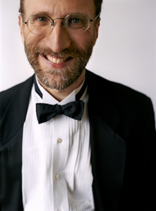
Roger Wiesmeyer
“I just adore it.” says Roger Wiesmeyer, speaking of Mozart’s Piano Concerto No. 24 in C minor, K. 491. “I’ve never played it on piano before. I’ve sat in the orchestra for performances of this concerto three or four times and every time it just completely captures my imagination, for at least the week after – I’ll have at least two weeks of living with it and thinking about it all the time. There is this incredible mood that Mozart casts with this piece.”
A few days ago Roger and I sat down after a rehearsal to talk about this piece, which we will be collaborating together to perform this week. Roger will be performing the solo piano part – the part originally played by Amadeus himself – and I am playing a reduction of the orchestra’s part on second piano for the first and third movements. The second movement – a slow Larghetto – will be performed by Roger joined by Nashville Symphony musicians Kate Ladner, flute; Jeremy Williams, violin; and Keith Nicholas, cello in a quartet arrangement by Johann Nepomunk Hummel, an Austrian composer and pianist who was a contemporary of Beethoven.
What Kind of Human Being Do You Want To Be?
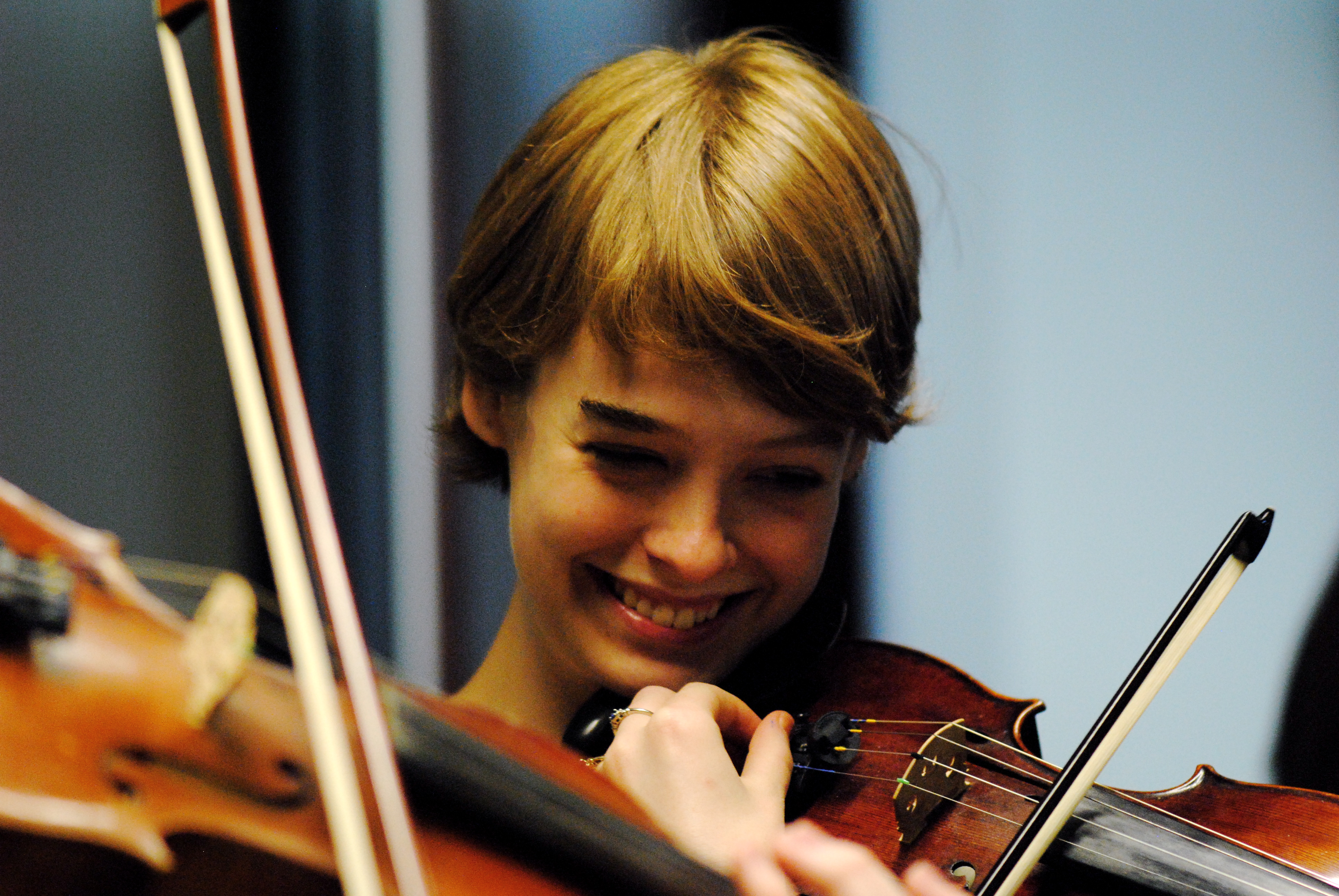
Music Education and the Whole Child
This weekend I attended a chamber music recital presented by a small local community music school. Roughly twenty students from middle and high school presented an hour of short pieces for small ensembles: music for woodwinds and strings, with a couple of pieces featuring voice as well. The students represented a wide range of experience, accomplishment, and commitment; some of these children will go on to study music in college and perhaps even pursue professional careers as performers or educators, while others will likely put their instruments away for good by the time they graduate from high school.
Regardless of the differences in commitment for the students and their families – to say nothing of the teachers – all of them clearly regard music as an important part of their lives. Parents make it possible for their children to attend weekly lessons and regular ensemble rehearsals, have the instruments and other materials they need, and the students must exert consistent effort over a long period of time (years) to learn how to play their instruments and develop at least enough acumen that they derive satisfaction from the process.
Why do they do it?
Anton Bruckner and his Romantic Symphony
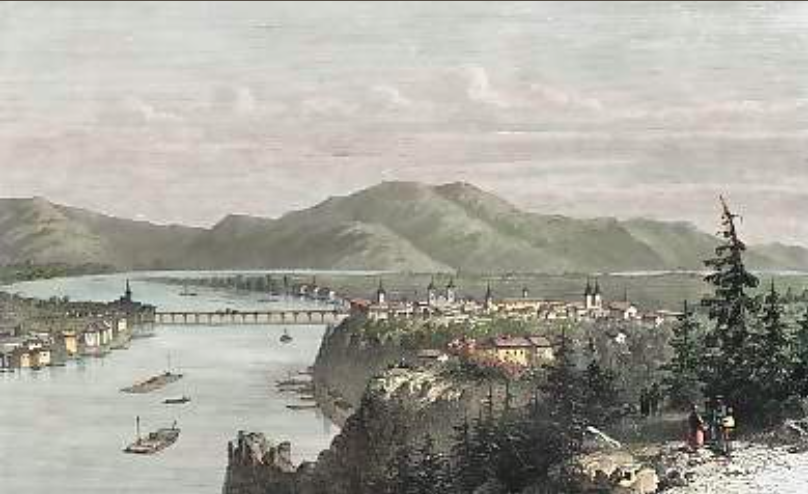
Linz, Austria ~ engraving by J. Ouartlev, 1863
Austrian composer and organist Anton Bruckner is primarily known today for his symphonies – his music is often paired with that of Gustav Mahler as the apotheosis of the late Romantic Austro-German symphonic tradition. Although Bruckner and Mahler symphonies share many characteristics – a common musical heritage and language, the robust late nineteenth century orchestra, sprawling scales and harmonies in which the symphony seems to encompass an entire world of expression – in many ways their music also differs. Mahler was 36 years younger than Bruckner, whom Mahler admired and considered his forerunner – at 17 years old, Mahler was present at the premiere of Bruckner’s Third Symphony in 1877. Mahler famously said “A symphony must be like the world. It must contain everything.” and his symphonies contain myriad references to themes, experiences, and objects from life. Many of Mahler’s symphonies incorporate vocal soloists and chorus – and hence text – whereas Bruckner’s symphonies are without exception purely instrumental works (which is interesting to note as Bruckner also composed many sacred choral works in addition to his symphonic output). Bruckner’s symphonies inhabit a more abstract, elemental “tone world” than Mahler’s – every bit as overwhelming, inspiring, and at times terrifying as Mahler’s, but for the most part at more of a remove from direct references to the world we live in. The Romantic Fourth Symphony is an exception.
An Interview with Matthew Halls

Matthew Halls (photo credit Eric Richmond)
Part 1 of 3
This week Matthew Halls is in Nashville to conduct the Nashville Symphony in four performances of Johann Sebastian Bach’s six Brandenburg Concertos, complete in one concert. The performances will be held October 22-25 and feature Mark Niehaus, trumpet, and Jun Iwasaki, violin. Tickets are available here.
British conductor Matthew Halls is one of the most versatile musicians in classical music today. In the early years of his career he worked as a keyboard player and early music conductor but he is known today for his dynamic work in music of all periods. Matthew Halls is Artistic Director of the Oregon Bach Festival, and conducts symphony orchestras and opera all over the world.
I was very fortunate to have the opportunity to sit down with Matthew and talk about music and his career for an hour this week before rehearsals began – here follows a transcript from our conversation.
How to Teach Recorder Fingerings
This post is especially for those teaching the recorder to children in school settings – but it might be worth a look if you are learning how to play the instrument as well.

playing recorder with Blue Rock School students, 1991
I hope that this brief post will be helpful to those teaching recorder in elementary school who have little or no background with the instrument as players themselves. My impression is that most elementary school music teachers haven’t actually studied recorder for its own sake (e.g taken lessons, played in a consort or performed solo recitals on recorder, etc.). I thought about the topic of this post recently when I remembered that I have never encountered middle or high school students that had been taught recorder in elementary school (by someone other than me) who were familiar with this system.
Francesco da Milano
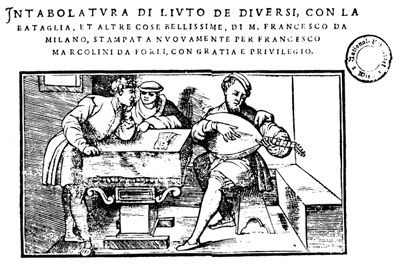
woodcut (of Francesco da Milano?) ~ the cover of Intabolatura di liuto published in Venice in 1536 by Francesco da Forli
The Lute Part II
In one of my first lute lessons with Pat O’Brien (c. 1993) I must have enthused about the music of Francesco da Milano, which I had been listening to on one of the first CDs of lute music I came across at Tower Records, a collection of this composer’s works played by Paul O’Dette that had just been released by Astrée. (This superb recording – still one of my very favorites – is now out of print.)
In what I was to learn was Pat’s typical unrestrained style, he took down two large, thick, heavy, volumes off of the bookshelves that lined the back wall of his studio – or perhaps dug them out from under a pile of other books, I don’t remember – and put them in my hands. This was Arthur Ness’s monumental The Lute Music of Francesco Canova da Milano published by Harvard University Press in 1970, which by then I believe was out of print and generally difficult to come across. American musicologist Arthur Ness is to Francesco like Ludwig von Köchel is to Mozart: Ness was the first to collect all Francesco’s known works from prints and manuscripts found in libraries all across Europe, catalog, and number them. As Mozart’s works are known by their Köchel numbers, Francesco’s extant pieces are known and differentiated by their Ness numbers – especially helpful as more than ninety of them are either untitled or simply named Fantasia or Ricercar in the original sources.
The Brandenburg Concertos

disputed portrait of Sebastian by Johann Ernst Rentsch the Elder (d. 1723) painted c. 1715, which would make him 30 years old here. Sebastian wrote the Brandenburgs in his early- to mid-thirties and submitted them to the Margrave in 1721
Johann Sebastian Bach’s Brandenburg Concertos are in the front rank of the masterpieces of Western music, and are his most-performed and best-known works. Ironically, these remarkable pieces are not simply the best or most popular works from a large number of similar efforts, as for instance is the case of Vivaldi’s The Four Seasons – they are unique in Sebastian’s oeuvre in almost every way. The Brandenburgs are not representative of Sebastian’s output except in the masterful manner of their composition and in the virtuosic forces needed to perform them.
Nashville Early Music Festival 2015: Saturday
Part 2 of 2
This is the conclusion of the story I began in Nashville Early Music Festival 2015: Prelude & Friday

Participants Chorus – Mareike Sattler is not pictured as she was taking the photo
Saturday
On Saturday morning I made it back to Lipscomb before the 9 am voice masterclass in Ward Hall with Margaret Carpenter. Brooke sang first and worked with Margaret for a half hour, followed by countertenor Patrick Dailey, who sang Thomas Campion’s Never Weather-Beaten Saile: another lute song, which I also accompanied. Margaret had many helpful suggestions for each singer – mostly focusing on expression – and the hour went by quickly. I ended up staying in the room for the next session as well – Participants Chorus with Terri Richter and Mareike Sattler – and served as impromptu accompanist as we sight read sections of Vivaldi’s Gloria.
 Walter Bitner