
Home » Posts tagged 'Early Music' (Page 3)
Tag Archives: Early Music
The Hallelujah Chorus
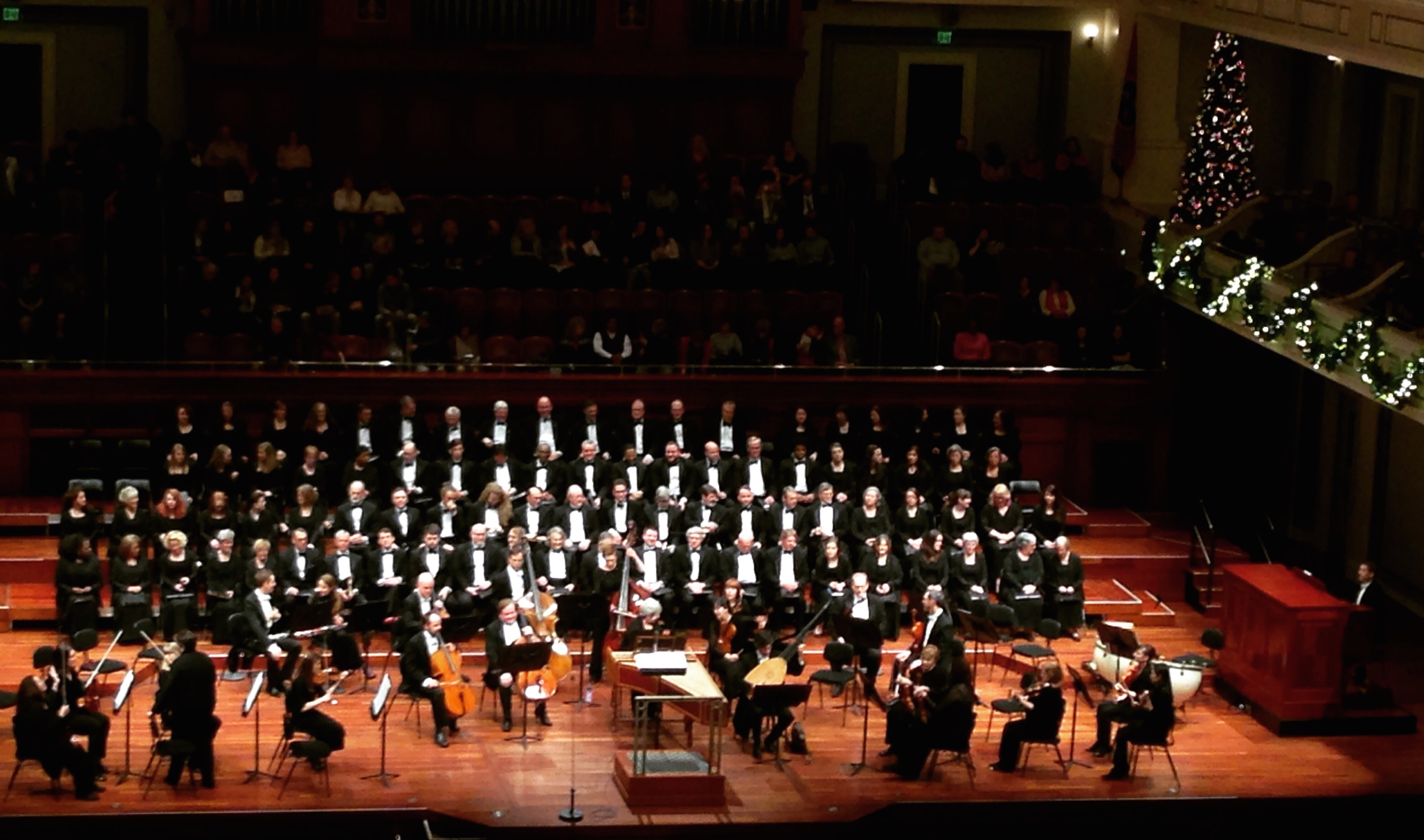
The Nashville Symphony and the Nashville Symphony Chorus gather onstage moments before a performance of Händel’s Messiah, December 18, 2016, Schermerhorn Symphony Center, Nashville
Part of a series of articles on
Preparing a School Winter Solstice Performance
This past week the Nashville Symphony performed our annual string of December Messiah concerts. An annual event featuring a different conductor and vision for the performance of this masterwork each year, it is remarkable to me how resilient Händel’s Messiah is, and how much the community here at the symphony -as well as the larger surrounding community of Music City – looks forward to it every year. It’s one of those monuments of the repertoire that has become part of the collective consciousness.
This year’s performance with guest conductor Christopher Warren-Green brought a historically-informed perspective to the performance, with brisk tempi and the incorporation of a theorbist who doubled on baroque guitar to the continuo section. I was thrilled to hear how excited our musicians were about Messiah this year in conversations I had with them (or overheard) during rehearsals. Sitting in the balcony on Sunday afternoon for the final matinee performance, the enthusiasm of the musicians and the audience was palpable. In the exhilaration following the concert I found myself thinking a lot about this remarkable piece of music, and especially one movement in particular – the unique and absolutely one-of-a-kind Hallelujah Chorus – and why and how it occupies such a singular place in our musical culture.
The Capirola Lute Book
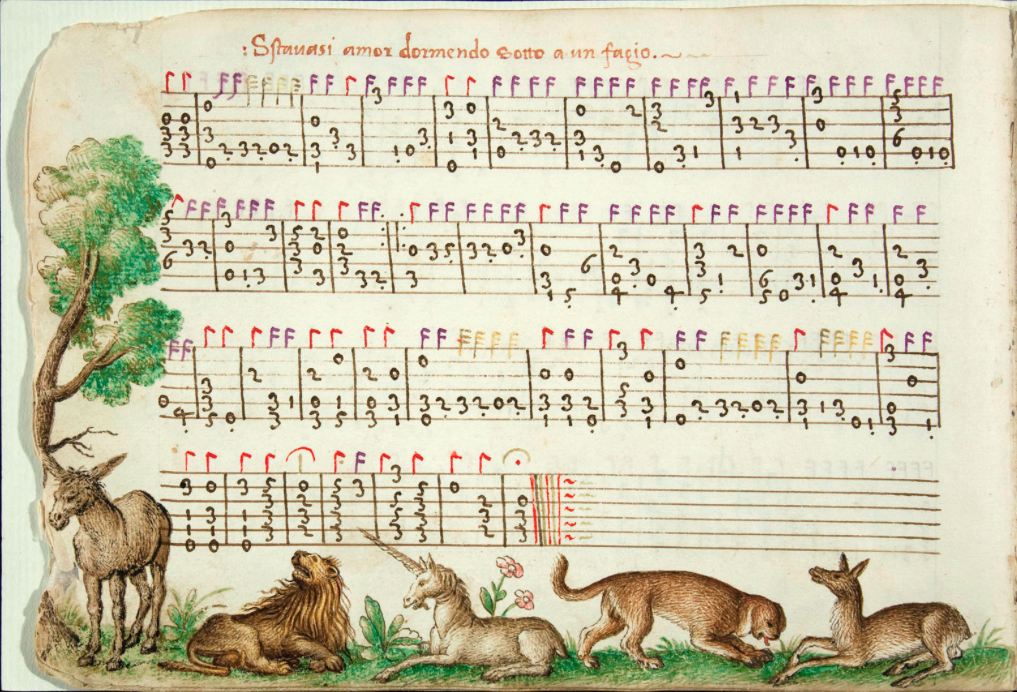
a page from the Capirola Lute Book (click to enlarge)
The Lute Part IX
In the early 16th century an amateur lutenist in Venice compiled an undated manuscript consisting of lute pieces in Italian tablature composed by his teacher. He names himself Vidal in the book’s preface, and states that in order to ensure that the music contained in its pages is preserved, he has decorated it with “noble pictures” so that it will be treasured for their sake should the book come into the possession of some who may not appreciate music. Indeed, 45 of the manuscript’s 147 pages feature elaborate pastoral illustrations in full color, and the book has been preserved: this is the famous Capirola Lute Book. It is one of the earliest and finest manuscripts of lute music to survive – perhaps the most beautiful – and it contains the only known selection of music by one of the the early 16th century’s finest lutenists, a Brescian nobleman named Vincenzo Capirola.
The Frottolists and the First Lute Songbooks

Un Concerto, c. 1485-1495 by Lorenzo Costa (1460-1535) ~ National Gallery, London
The Lute Part VIII
continued from
Ottaviano Petrucci and the First Printed Lute Books
From the end of the 15th century into the first decades of the 16th century – a period estimated by historians to be from about 1470-1530 – a secular polyphonic song genre known as frottola flourished throughout the courts of Italy. This poetic and musical movement paved the way for a distinctly Italian musical renaissance style featuring primarily Italian musicians and composers in contrast to the dominance of composers from Northern Europe in Italy from the 14th – 15th centuries, and prepared a fertile ground for the development of the madrigal later in the 16th century.
Hand in hand with the rise of the frottola was the development of a revolutionary technique that allowed musicians to play polyphonic music in 2, 3, or more parts on one lute. By the end of the 15th century, most lutenists had dropped their plectrums in favor of the new style, and plucked the strings with the fingers of the right hand. When Petrucci published the first books of lute tablature beginning in 1507, all of them and all of the tablature that followed for the next next two and a half centuries assumed the new technique.
Ottaviano Petrucci and the First Printed Lute Books

Frontispiece of Harmonice Musices Odhecaton ~ Canti A (1501) by Ottaviano Petrucci
The Lute Part VII
He did not compose for lute nor was he known to perform on it, but Ottaviano Petrucci (1466 – 1539) was nonetheless a vital figure in the history of the instrument, and profoundly influenced the course of musical development in the 16th century, and indeed music history in general.
Petrucci was an Italian printer and a pioneer in the publication of music printed from moveable type. In Venice at the very beginning of the Cinquecento, Petrucci produced the first known example of printed polyphonic music: a collection of secular songs titled Harmonice Musices Odhecaton, in 1501.
He also was the first to print instrumental music: several books of lute tablature, produced in 1507 and 1508. Today he is known as the father of modern music printing.
In Dulci Jubilo

the opening of In dulci jubilo, Piæ Cantiones, 1582
Part of a series of articles on
Preparing a School Winter Solstice Performance
In dulci jubilo is a famous medieval Christmas carol. It is a macaronic carol (i.e. the text is in a mixture of languages): the original text alternates between German and Latin. The words are attributed to the German mystic (and student of Meister Eckhart) Heinrich Seuse (1295 – 1366), and describes his vision of singing angels dancing with him.
It is one of our oldest, loveliest, and most important carols. The lilting, singsongy, exuberant melody and the relative ease with which they were able to learn it made it popular with my students of all ages – from elementary through high school. Although not a piece I included as an annual repeating feature of Winter Solstice performances, I would program In dulci jubilo every few years, and most of my students sang or played it in a Winter Solstice production at some point.
Personent Hodie

Part of a series of articles on
Preparing a School Winter Solstice Performance
Personent Hodie is a medieval Christmas carol. The form in which it comes down to us was first published in Piæ Cantiones, a collection of medieval Latin songs that were sung at the cathedral school in Turku (Finland). It was compiled by Jaakko Suomalainen, a Finnish clergyman, and published in 1582. The carol’s melody is very similar to a hymn found in a German manuscript from 1360, and it is assumed that Personent Hodie dates from the mid-14th century.
The Lute Society of America Summer Seminar West, 1996

masterclass with Paul O’Dette, Lute Society of America Summer Seminar West, Vancouver Early Music Festival 1996
The Lute Appendix iv
In the summer of 1996, I attended The Lute Society of America‘s Summer Seminar West in Vancouver, BC. The event took place from July 29 – August 2, 1996 at the Vancouver Early Music Festival held at The University of British Columbia.
Earlier this month the LSA held the 2016 summer seminar at Case Western Reserve University in Cleveland, and as my FaceBook feed was briefly inundated with photos and videos that attendees posted on the LSA FaceBook Group, I found myself reminiscing about my experience in Vancouver twenty years ago. It was one of the most memorable weeks of my life.
BACHanalia 2016

our friend Sebastian
Next Friday, April 15, from 5 – 11 pm, more than 100 Nashville musicians align efforts to perform the 10th Annual BACHanalia at Christ Church Cathedral, 900 Broadway in downtown Nashville. This unique, beloved event is a continuous, six hour concert of our friend Sebastian’s music presented once a year as a gift to the community. Click here for the church’s official announcement of the event.
In past years I have brought student ensembles to perform in this event, and this year I am fortunate to be performing myself. I was also very lucky, and was leaked a sneak peak at BACHanalia 2016‘s performers and selections, which I am now going to share with you here, dear readers of Off The Podium. Warning: Spoilers Ahead!
Meet Telemann

To his 18th century contemporaries, Georg Philipp Telemann was the most famous, influential, and highly-regarded German musician of the day. Four years older than his friends J.S. Bach and Händel – both of whose reputations have now eclipsed his – Telemann was more prolific than either, wrote sacred and secular, vocal and instrumental music in virtually every genre, published on a nearly unprecedented scale, and did more than any other musician of his time to break down barriers that kept music a separate and elite component of civic, court, and church ceremony to elevate the role of music in the life of the middle class.
Music City Baroque & Vox Grata: Music from the Venetian Ospedali

Music City Baroque & Vox Grata perform music from the Venetian Ospedali, January 24, 2016, Westminster Presbyterian Church, Nashville ~ photo by George Riordan
Like much of this part of the country, last week Nashville was hit by a record snow storm – the largest snowfall recorded here in the last 28 years. Between 5 and 10 inches fell on Friday and Saturday, depending on what part of town you live in (8 inches was the official recorded snowfall at Nashville International Airport).
When snow falls here the city shuts down. Not only do schools and businesses close, but it’s simply not safe to be on the roads. We have few plows and they only attempt to clear main roads, leaving most neighborhoods treacherous and ice-bound. My family did not leave our house on Friday or Saturday, except on foot to walk the dog or to scout out the state of neighboring streets.
So by Sunday afternoon, when the city had begun to thaw out, I was happy to make my way across town to hear an afternoon concert of old music performed in collaboration by two local ensembles.
 Walter Bitner