
Home » Nashville Symphony Archives 2014-2019 (Page 6)
Category Archives: Nashville Symphony Archives 2014-2019
Understanding Accelerando: FAQ
 Our very first auditions for Accelerando are around the corner: applications and all supporting materials are due by Friday, March 4, and auditions will be held at W.O. Smith Music School on Saturday, March 12.
For the last two months, our Education & Community Engagement Department here at the Nashville Symphony has held information sessions out in the community and fielded many questions by email and phone as we seek to find the right students to begin this groundbreaking program this year.
Accelerando is a unique music education initiative distinct in many ways from other music education programs in Middle Tennessee. In order to foster greater understanding of the goals of Accelerando, what the program entails, and who is eligible to participate, I have compiled here a list of some of the most frequently asked questions we have received about Accelerando – together with some responses.
Pictures at an Exhibition
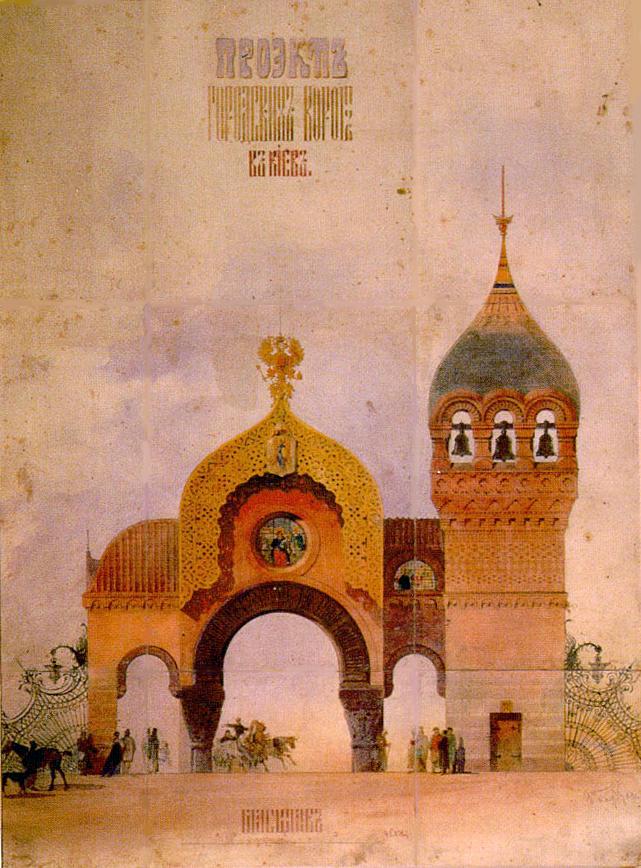
Viktor Hartmann: Plan for a City Gate in Kiev, watercolor, 1869
Modest Mussorgsky (1839 – 1881) was a Russian composer best known today for a few celebrated works, including Night on Bald Mountain – a musical depiction of a “witches sabbath” most often played on Halloween programs and other programs depicting musical grotesqueries – and Boris Gudunov, an opera based on a drama by Pushkin: the butt of one of the first classical music jokes music majors learn in undergraduate school:
Q: Why did Mussorgsky only write one opera?
A: Because one Boris Gudunov.
His most beloved composition today is Pictures at an Exhibition, which was originally written as a large suite for solo piano but is best known to the listening public as a large-scale symphonic work in its orchestration by the French composer Maurice Ravel (1875 – 1937).
2016 SphinxCon: Ignite to Action
 Earlier this month I traveled to Detroit to attend SphinxCon – the 4th annual conference on diversity in the arts presented by The Sphinx Organization. This was my first experience attending this conference, and it was a good experience, and particularly relevant to the work my department has been intensely engaged in: we are now in the midst of launching the Nashville Symphony’s new diversity program Accelerando. Our very first auditions for Accelerando will be held on March 12.
I returned to Nashville a week ago for a schedule turned upside down due to snowstorms, but many of my impressions from the weekend in Detroit have stayed with me, and I’ve tried to write down some of them here before the march of time goes on much longer and they recede into the background.
Mellon Foundation Awards $959,000 to Accelerando
The Andrew W. Mellon Foundation has awarded a $959,000 grant to provide major funding for the Nashville Symphony’s Accelerando music education initiative over the next six years.
2015: What Kind of Blog Is This?

2015 Off the Podium Reflections, Statistics, and Top Ten Posts
Disclosure: self-indulgent meta-post follows
It’s the last week of 2015, and looking back I decided to review my experience writing Off the Podium this year and share some statistics, what I have learned, and in a way give an overview of what exactly this blog is about.
Writing has been something I have wanted to do for years now, and I began to write in secret some time ago, but it was last year’s career transition that found me leaving the classroom to work at the symphony that finally enabled me to begin writing in earnest. I just couldn’t put it off any more!
The Accelerando Begins
This fall, Nashville Symphony Education & Community Engagement staff have been very busy not only with the delivery of the Symphony’s current education and community programming as often described here on Off the Podium, but with preparations for the launch of our new Accelerando program in 2016.
The launch of Accelerando was announced at a press conference on September 28, and we have been working closely for the last months with representatives from the orchestra and from our community partners – and with others both within our community and beyond – to plan all the details of the launch and make plans for what amounts to the establishment of a small but intensive music school for students from underrepresented communities based here at Schermerhorn Symphony Center, but reaching in many directions out into the community.
Education & Community Engagement at the Nashville Symphony: Fall 2015 Review

from my Instagram feed: your Nashville Symphony Education & Community Engagement Department: (l to r) Kelley Bell, Walter Bitner, Kristen Freeman ~ during a break from filming
December is here and the holidays are upon us. Having made it through Thanksgiving already and fearing that Christmas and New Year’s may arrive before I do this, I am dedicating this post to a look back on the activities of our department this fall.
As I wrote this post, I became astounded at the ground we have covered in just the last four months – the depth of the Nashville Symphony’s engagement in our community and the wide range of educational activities we offer is truly remarkable. I am so proud to be able to come to work every day and participate in all of this!
Roger Wiesmeyer Plays Mozart

Roger Wiesmeyer
“I just adore it.” says Roger Wiesmeyer, speaking of Mozart’s Piano Concerto No. 24 in C minor, K. 491. “I’ve never played it on piano before. I’ve sat in the orchestra for performances of this concerto three or four times and every time it just completely captures my imagination, for at least the week after – I’ll have at least two weeks of living with it and thinking about it all the time. There is this incredible mood that Mozart casts with this piece.”
A few days ago Roger and I sat down after a rehearsal to talk about this piece, which we will be collaborating together to perform this week. Roger will be performing the solo piano part – the part originally played by Amadeus himself – and I am playing a reduction of the orchestra’s part on second piano for the first and third movements. The second movement – a slow Larghetto – will be performed by Roger joined by Nashville Symphony musicians Kate Ladner, flute; Jeremy Williams, violin; and Keith Nicholas, cello in a quartet arrangement by Johann Nepomunk Hummel, an Austrian composer and pianist who was a contemporary of Beethoven.
Anton Bruckner and his Romantic Symphony

Linz, Austria ~ engraving by J. Ouartlev, 1863
Austrian composer and organist Anton Bruckner is primarily known today for his symphonies – his music is often paired with that of Gustav Mahler as the apotheosis of the late Romantic Austro-German symphonic tradition. Although Bruckner and Mahler symphonies share many characteristics – a common musical heritage and language, the robust late nineteenth century orchestra, sprawling scales and harmonies in which the symphony seems to encompass an entire world of expression – in many ways their music also differs. Mahler was 36 years younger than Bruckner, whom Mahler admired and considered his forerunner – at 17 years old, Mahler was present at the premiere of Bruckner’s Third Symphony in 1877. Mahler famously said “A symphony must be like the world. It must contain everything.” and his symphonies contain myriad references to themes, experiences, and objects from life. Many of Mahler’s symphonies incorporate vocal soloists and chorus – and hence text – whereas Bruckner’s symphonies are without exception purely instrumental works (which is interesting to note as Bruckner also composed many sacred choral works in addition to his symphonic output). Bruckner’s symphonies inhabit a more abstract, elemental “tone world” than Mahler’s – every bit as overwhelming, inspiring, and at times terrifying as Mahler’s, but for the most part at more of a remove from direct references to the world we live in. The Romantic Fourth Symphony is an exception.
An Interview with Matthew Halls

Matthew Halls (photo credit Eric Richmond)
Part 1 of 3
This week Matthew Halls is in Nashville to conduct the Nashville Symphony in four performances of Johann Sebastian Bach’s six Brandenburg Concertos, complete in one concert. The performances will be held October 22-25 and feature Mark Niehaus, trumpet, and Jun Iwasaki, violin. Tickets are available here.
British conductor Matthew Halls is one of the most versatile musicians in classical music today. In the early years of his career he worked as a keyboard player and early music conductor but he is known today for his dynamic work in music of all periods. Matthew Halls is Artistic Director of the Oregon Bach Festival, and conducts symphony orchestras and opera all over the world.
I was very fortunate to have the opportunity to sit down with Matthew and talk about music and his career for an hour this week before rehearsals began – here follows a transcript from our conversation.
 Walter Bitner