
Home » Music (Page 14)
Category Archives: Music
Nashville Early Music Festival 2015: Saturday
Part 2 of 2
This is the conclusion of the story I began in Nashville Early Music Festival 2015: Prelude & Friday

Participants Chorus – Mareike Sattler is not pictured as she was taking the photo
Saturday
On Saturday morning I made it back to Lipscomb before the 9 am voice masterclass in Ward Hall with Margaret Carpenter. Brooke sang first and worked with Margaret for a half hour, followed by countertenor Patrick Dailey, who sang Thomas Campion’s Never Weather-Beaten Saile: another lute song, which I also accompanied. Margaret had many helpful suggestions for each singer – mostly focusing on expression – and the hour went by quickly. I ended up staying in the room for the next session as well – Participants Chorus with Terri Richter and Mareike Sattler – and served as impromptu accompanist as we sight read sections of Vivaldi’s Gloria.
Nashville Early Music Festival 2015: Prelude & Friday
 Part 1 of 2
This past weekend I had the great pleasure of participating in Music City’s first ever festival dedicated to music from before the time of Haydn, Mozart, and Beethoven. The inaugural Nashville Early Music Festival was held Friday & Saturday, September 25 & 26 at Lipscomb University (the festival’s sponsor), and included copious performances of (mostly) baroque music by local musicians as well as visitors from around the country, as well as more informal presentations, masterclasses, and opportunities for musicians, students, and anyone else interested in Early Music to listen, learn, converse, enthuse, and make friends.
I know that I am not alone in hoping that this is only the first annual event for a festival that will grow into a tradition, bringing Early Music to Nashville for years to come.
Meet the Lute
Is it not strange that sheep’s guts could hail souls out of men’s bodies?
William Shakespeare
Much Ado About Nothing, 2.3.57-58

musician angel by Rosso Fiorentino (Giovanni Battista di Jacopo), circa 1520
The first in a series of posts about the lute.
I would wager that while many, perhaps even most people in our culture have heard of the instrument called the lute and may even know what it looks like, most have never heard one played – either live or on a recording. Yet this paragon of musical instruments, this “instrument of angels” was the most popular instrument in Europe for hundreds of years. Throughout the Renaissance, the lute occupied a position in European society analogous to that of the piano in the nineteenth century. Lute virtuosi played for royalty and popes and were famous throughout the continent, and a rising middle class created demand for the new industry in printed sheet music, providing for music making at home. The art of music took its place at the center of culture on an unprecedented scale. This musical revolution gave birth to the invention of the instruments we use today and intensified the position of music at the heart of both religious and secular ceremonies, while the public and royalty alike acknowledged famous musicians as celebrities and prophets. At the forefront of all this was the lute – a symbol of music’s divine place in human life and the most popular musical instrument of the age.
Nashville is Music City
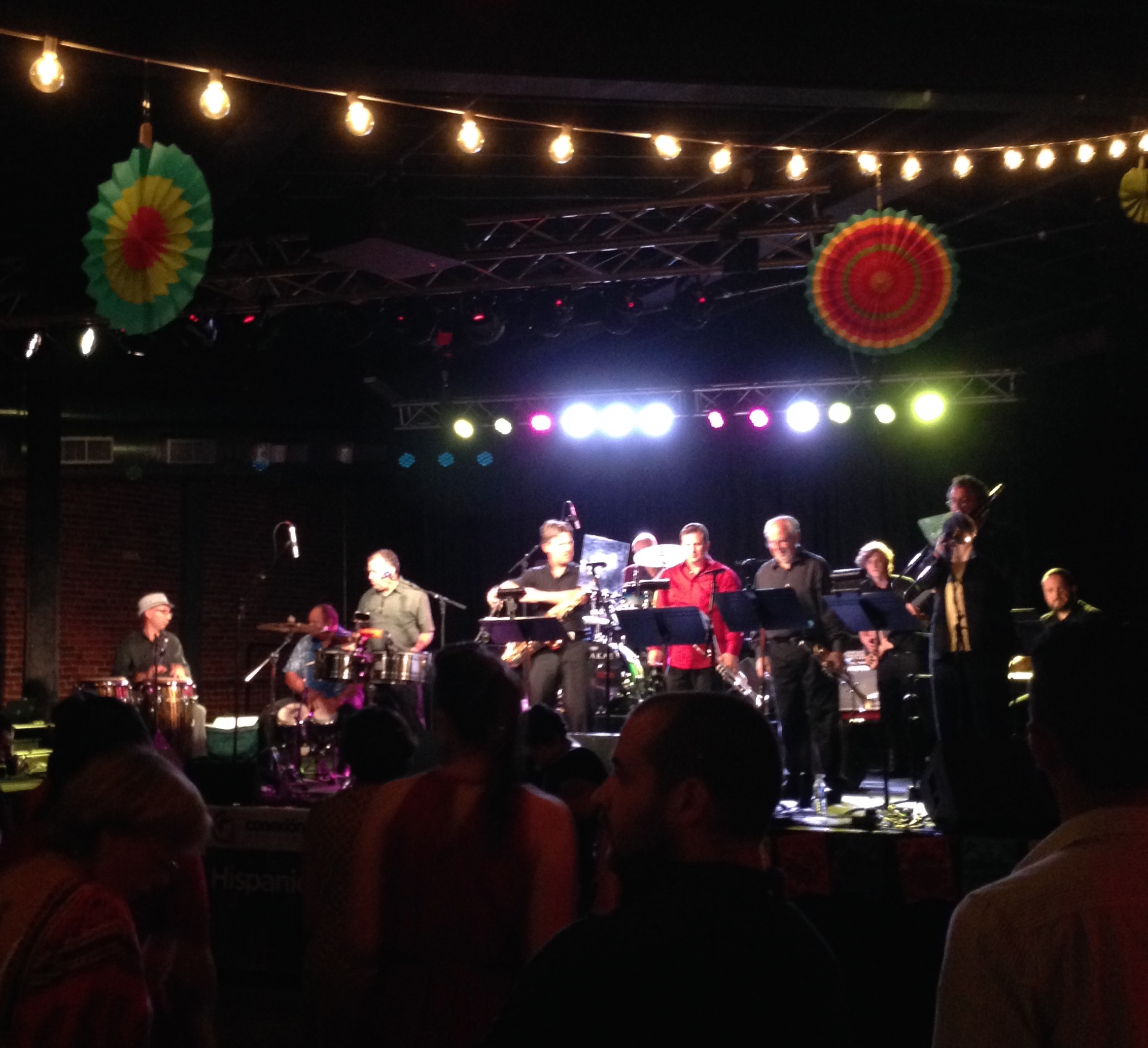
Lalo Davila & Friends hold forth at Conexión Américas’ Hispanic Heritage Celebration #THELATINPARTY at The Cannery Ballroom, Nashville, September 12, 2015
This weekend has been a typical example of how incredibly diverse and dynamic the music scene is in this town – and I’m only speaking for events/activities I witnessed or was a part of.
For today’s post I depart from my usual in-depth-article format and bring to you a brief, breezy, gossip-column style rundown of my weekend.
As anybody who’s lived here for any length of time knows, this cornucopia of musical delights is typical of what Nashville has to offer on a regular basis. It’s simply the best town to be a musician or a music lover in, period.
Solfège With Amadeus
 Part 4 of a 4-Part Series
Go to Part 1: The Joy of Solfège
Go to Part 2: The Legacy of Guido d’Arezzo
Go to Part 3: Teaching Music With Solfège
This Epilogue to my series of posts on Solfège recounts examples of solfège exercises I used in high school choir rehearsals, some anecdotes about singing Mozart’s Requiem on solfège syllables, and some unexpected things we learned from doing this.
Teaching Music With Solfège
 Part 3 in a 4-part series
Go to Part 1: The Joy of Solfège
Go to Part 2: The Legacy of Guido d’Arezzo
This is a simple but somewhat thorough description of the syllables for movable do solfège with la-based minor and how I applied them in my work as a teacher. I do not claim this method as an example of haute Kodály, Gordon, or any other technique – for me solfège was always a means to an end, not an end in itself. We used it for exercises to develop skills, and to learn notes accurately – and when these goals were achieved we left it behind.
The Legacy of Guido d’Arezzo
Part 2 in a 4-part series

Go to Part 1: The Joy of Solfège
Solfège is a practical method for teaching sight-singing (singing music from written notation). Each note of the diatonic scale is assigned a solfège syllable. This practice is called solmization.
The Joy of Solfège
 Part 1 in a 4-part series
Most of the country is still enjoying summer vacation, but here in Nashville the school year begins the first week of August – no lie. This will be the first fall in many years that I am not starting a new school year as a teacher, although I am still vicariously experiencing it as a parent. Forgive me if I wax nostalgic.
For all of my teaching career – save for 2008 – 2011 when I ran the piano studio at Nashville School of the Arts and simultaneously directed Music City Youth Orchestra – I was in some part, often for the most part, a singing teacher. And so it is natural for my thoughts to turn, at this time of year, to the wonders of solfège. For so many years, the use of this invaluable tool, the practice of this incomparable method was a staple of my daily life. How many thousands of hours have I spent solfèging songs or vocal parts, or teaching students to do so, or doing it with them? How could I have done my work without it? Oh thou noble art. (more…)
Vanderbilt Music & Mind Kickoff
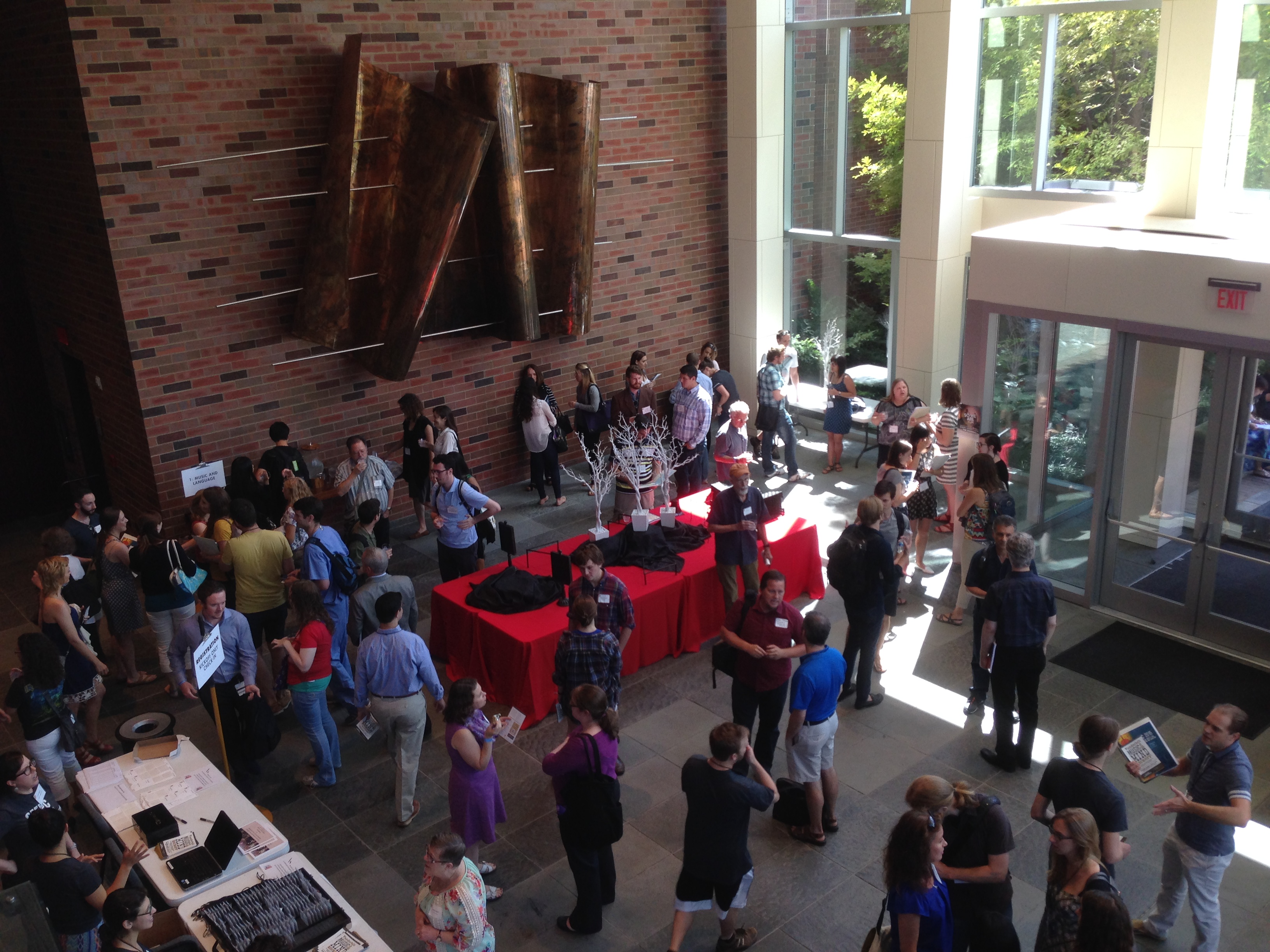
Ingram Hall lobby during a break at the Vanderbilt Music & Mind Kickoff to the Society for Music Perception and Cognition 2015 Conference, August 1, 2015
This week (August 1-5) Vanderbilt University hosted the biennual Conference of the Society for Music Perception and Cognition. Many scientists and researchers from around the world descended on Music City to attend the five-day meeting, attending lectures, presentations, symposiums, and other events. The week’s activities are a means for scientists, musicians, and others to share and learn about the many facets of current research in music understanding from a far-flung collection of fields including music theory, psychology, psychophysics, linguistics, neurology, neurophysiology, ethology, ethnomusicology, artificial intelligence, computer technology, physics, and engineering.
On Saturday, August 1, Kelley Bell (Nashville Symphony Education & Community Engagement Program Manager) and I attended the Music & Mind Kickoff event on the opening day of the conference, which was held at Blair School of Music’s Ingram Hall.
Meet Olga Scheps
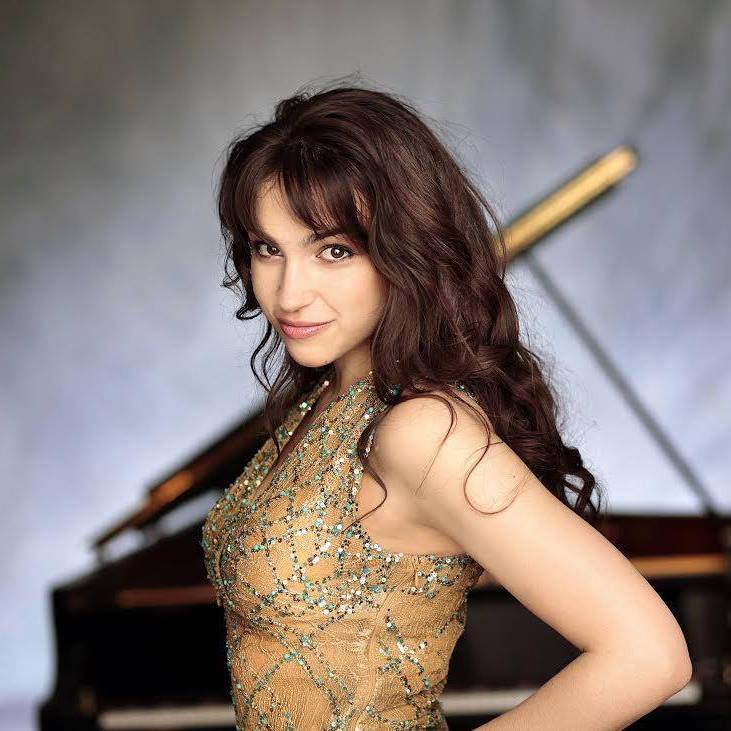
Photo: Uwe Arens / Sony classical
Olga Scheps seems poised to take on the world. A young pianist with extraordinary powers of expression, Olga has been enchanting audiences throughout Europe for several years but seems to be little known in the United States, or in the general English-speaking world. From what I have been able to learn, she has only appeared once in the U.S. – two performances of Liszt’s Concerto No. 2 with the San Antonio Symphony in 2012 – but from the pace of her concertizing and recording for the last few years, it seems like it will just be a matter of time before she begins to make similar strong impressions on music lovers on this side of the Atlantic. In 2015 alone so far Olga has performed either solo recitals or as concerto soloist with orchestras throughout Germany where she lives, in Spain, Wales, and Japan, and made debuts in Israel and Sweden. She records exclusively for Sony and has produced five CDs in the last six years – four solo recital discs and a luminous, touching recording of both Chopin concerti with Matthias Foremny and the Stuttgart Kammerorchester released in 2014. Her latest recording – Vocalise – was released in Germany on July 17.
Olga’s repertoire is a balanced combination of the very familiar (read: warhorses) and the seldom performed, and she brings to everything she plays a deeply considered emotional sensitivity to the impulses that drive the music. Although it is clear that she has the technical prowess and sheer muscle to pull off the grandest effects called for in the many masterpieces in her repertoire, it is the beautiful clarity of her approach to playing the piano and her attention to subtle details of expression which I find most remarkable.
 Walter Bitner