
Home » Posts tagged 'Music' (Page 14)
Tag Archives: Music
The Legacy of Guido d’Arezzo
Part 2 in a 4-part series

Go to Part 1: The Joy of Solfège
Solfège is a practical method for teaching sight-singing (singing music from written notation). Each note of the diatonic scale is assigned a solfège syllable. This practice is called solmization.
The Joy of Solfège
 Part 1 in a 4-part series
Most of the country is still enjoying summer vacation, but here in Nashville the school year begins the first week of August – no lie. This will be the first fall in many years that I am not starting a new school year as a teacher, although I am still vicariously experiencing it as a parent. Forgive me if I wax nostalgic.
For all of my teaching career – save for 2008 – 2011 when I ran the piano studio at Nashville School of the Arts and simultaneously directed Music City Youth Orchestra – I was in some part, often for the most part, a singing teacher. And so it is natural for my thoughts to turn, at this time of year, to the wonders of solfège. For so many years, the use of this invaluable tool, the practice of this incomparable method was a staple of my daily life. How many thousands of hours have I spent solfèging songs or vocal parts, or teaching students to do so, or doing it with them? How could I have done my work without it? Oh thou noble art. (more…)
Vanderbilt Music & Mind Kickoff
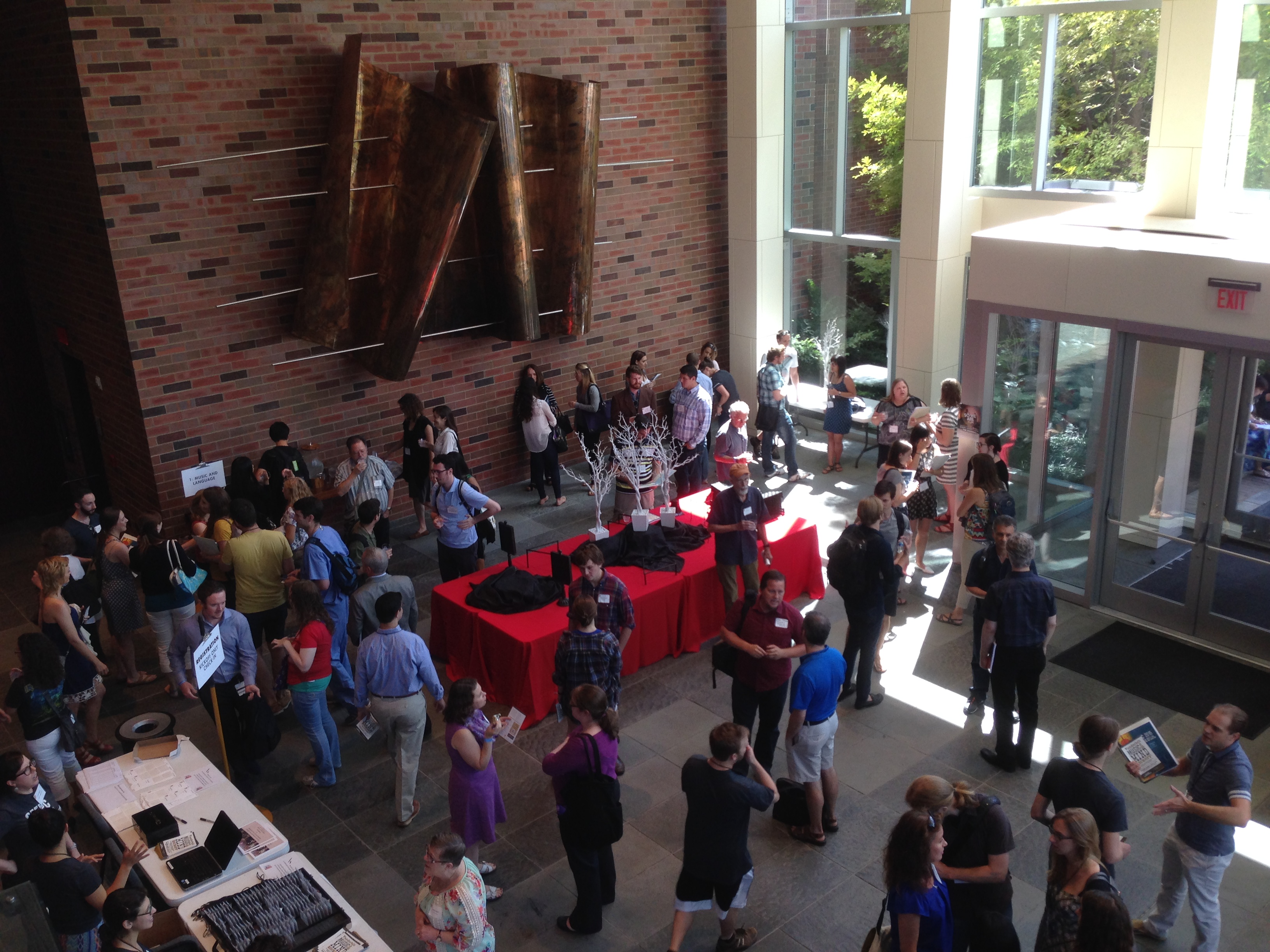
Ingram Hall lobby during a break at the Vanderbilt Music & Mind Kickoff to the Society for Music Perception and Cognition 2015 Conference, August 1, 2015
This week (August 1-5) Vanderbilt University hosted the biennual Conference of the Society for Music Perception and Cognition. Many scientists and researchers from around the world descended on Music City to attend the five-day meeting, attending lectures, presentations, symposiums, and other events. The week’s activities are a means for scientists, musicians, and others to share and learn about the many facets of current research in music understanding from a far-flung collection of fields including music theory, psychology, psychophysics, linguistics, neurology, neurophysiology, ethology, ethnomusicology, artificial intelligence, computer technology, physics, and engineering.
On Saturday, August 1, Kelley Bell (Nashville Symphony Education & Community Engagement Program Manager) and I attended the Music & Mind Kickoff event on the opening day of the conference, which was held at Blair School of Music’s Ingram Hall.
Meet Olga Scheps
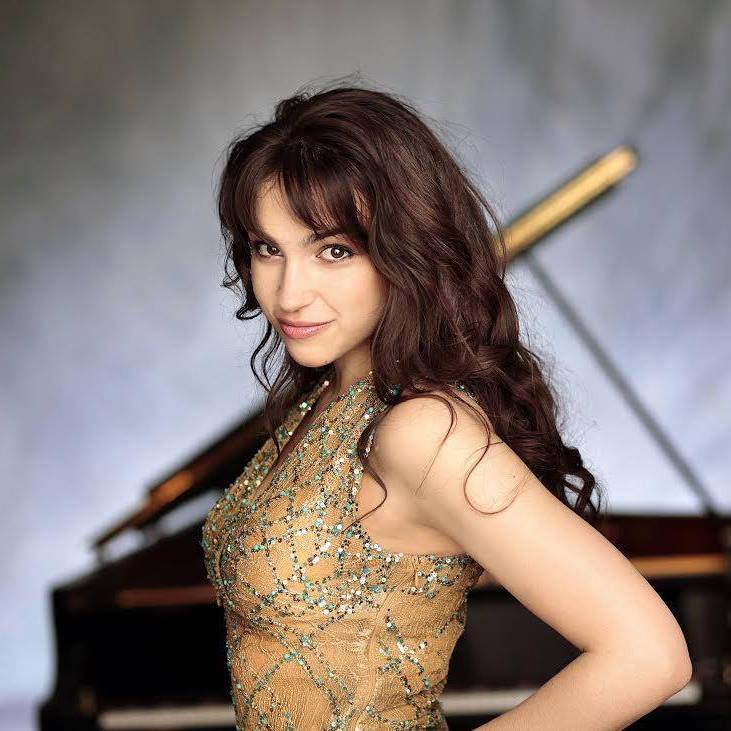
Photo: Uwe Arens / Sony classical
Olga Scheps seems poised to take on the world. A young pianist with extraordinary powers of expression, Olga has been enchanting audiences throughout Europe for several years but seems to be little known in the United States, or in the general English-speaking world. From what I have been able to learn, she has only appeared once in the U.S. – two performances of Liszt’s Concerto No. 2 with the San Antonio Symphony in 2012 – but from the pace of her concertizing and recording for the last few years, it seems like it will just be a matter of time before she begins to make similar strong impressions on music lovers on this side of the Atlantic. In 2015 alone so far Olga has performed either solo recitals or as concerto soloist with orchestras throughout Germany where she lives, in Spain, Wales, and Japan, and made debuts in Israel and Sweden. She records exclusively for Sony and has produced five CDs in the last six years – four solo recital discs and a luminous, touching recording of both Chopin concerti with Matthias Foremny and the Stuttgart Kammerorchester released in 2014. Her latest recording – Vocalise – was released in Germany on July 17.
Olga’s repertoire is a balanced combination of the very familiar (read: warhorses) and the seldom performed, and she brings to everything she plays a deeply considered emotional sensitivity to the impulses that drive the music. Although it is clear that she has the technical prowess and sheer muscle to pull off the grandest effects called for in the many masterpieces in her repertoire, it is the beautiful clarity of her approach to playing the piano and her attention to subtle details of expression which I find most remarkable.
Registration for 2015-16 Education Programming Opens July 27

Music Director Giancarlo Guerrero works with a student during Side-by-Side Concert rehearsals, May 20, 2015
Registration for many of the Nashville Symphony’s education programs for the 2015-2016 season will open on Monday, July 27 at 11 a.m.
Summer Education Internship at the Nashville Symphony

from my instagram feed, May 18, 2015: Nashville Symphony Education & Community Engagement Staff and Interns, Summer 2015
“The internship experience at the Nashville Symphony has been a dream come true.” says Margie Way-Kiani, one of our summer interns. “I’ve aways wanted a behind-the-scenes view of how the Nashville Symphony functions so successfully, and now I’ve had a small taste of that through the Education & Community Engagement Department.”
One of the Nashville Symphony’s many education programs, our internships provide opportunities for college students to gain experience working at not only a major American orchestra, but also the largest performing arts nonprofit in the state of Tennessee. Typically, an internship lasts a semester and is offered in the Fall, Spring, and Summer, following the usual academic calendar. This summer, the symphony is hosting an intern each in our Operations, Development, and Human Resources departments, and four interns in Education & Community Engagement.
Chris Squire 1948 – 2015

Chris Squire circa 1972 – from Fragile
Chris Squire, who laid down the bass line for much of the soundtrack of my adolescence, died yesterday of leukemia. He was 67.
Chris and Jon Anderson founded Yes in 1968. The band has gone through many permutations in personnel and evolution in style since then, but Chris has always been at the heart of the group. His unique sound, approach to playing bass, and contribution to crafting the group’s compositions have been an integral part of what makes Yes Yes. When Billy Sherwood joins the band on stage as bassist at the beginning of their North American Summer Tour in August, it will be the first time that Yes has ever performed without Chris since the band was formed 47 years ago.
Nashville Symphony: Your Community. Your Orchestra.

music director Giancarlo Guerrero speaks about the symphony’s role in the community in Nashville Symphony: Your Community. Your Orchestra.
I’m pleased to be able to share with you the music education advocacy video that was produced by our Communications team and Mogulboys this Spring – it is now publicly available on Youtube (see below). The video has already been viewed by thousands of symphony patrons since the beginning of May, including screenings at the annual Fashion Show on May 5 and before our many movie concerts in the hall during the month of June.
Nashville Symphony: Your Community. Your Orchestra features the symphony’s conductors and musicians both describing our organization’s commitment to music education as well as sharing personal anecdotes about the importance of music education in the life of the community.
Trust
This article is a companion to my previous post Wholehearted Attention.

from my Instagram feed: Nashville Symphony Education & Community Engagement Program Manager Kelley Bell guides a young guest in playing his first notes on the trumpet before our Community Concert at Centennial Park, Nashville, June 4, 2015
It’s generally accepted that one of the goals of education – beyond the attainment of specific content objectives – is to instill in the child a love for learning. It has been my experience however, that a love for learning is part of a child’s natural state and does not need to be instilled. Children who exhibit behavior to the contrary have most often faced social and/or emotional difficulties that impede their inherent wish to learn and grow; some of a teacher’s work involves trying to determine what these obstacles are and finding ways around them. Beyond providing the child an acquaintance with and proficiency in the broad array of subjects necessary for success in life, the overarching goal of education might be better described as enabling the child to become her own teacher.
Wholehearted Attention

Grannis Photography
Music teachers in school settings often feel a sense of isolation from the activities happening in other classrooms, and a lack of understanding on the part of other teachers and administrators about what it is, exactly, that music teachers teach. There are striking differences in the way teaching and learning happens in the music classroom when compared to the activities happening in other classes. In the current standards-obsessed education climate, appropriate musical activity in the classroom faces real obstacles in being appreciated, understood, and ultimately funded, because it resists being reduced to a checklist of objectives.
Which is not to say that there are not discrete objectives for a music teacher to impart to his or her students – quite the opposite, in fact. Music-making is such a complex activity that the act of separating all the components that go into it into easily assessed bytes of information ultimately leaves out essential aspects of what it is really about, presenting an incomplete picture at best, and at worst, a distorted view of the purpose and value of musical activity.
 Walter Bitner